Four articles from the 1880 edition — construction, gun-carriages, machine-guns and manufacture — 45 pages
Appleton’s Cyclopedia of Applied Mechanics was a general engineering encyclopedia, not a service manual — and that is exactly what makes its ordnance articles useful. Written for engineers rather than for gunners, they stop and explain the reasoning behind a gun instead of assuming it. This file gathers the four ordnance entries from the 1880 edition: Ordnance, Construction Of; Ordnance — Gun-Carriages; Ordnance — Machine-Guns; and Ordnance, Manufacture Of.
The date matters. 1880 is the hinge year in heavy ordnance. The article opens by saying so in as many words: within the last twenty years the art of using a gun “has been virtually transformed,” each more powerful gun serving “but as a challenge to the manufacture of armor capable of resisting the shot from that weapon.” England was still committed to the muzzle-loading rifle; Krupp was building breech-loaders in Essen; the United States had almost nothing new and was busy trying to convert its Civil War smooth-bores by lining them with wrought-iron tubes. All three positions are set out here side by side, with the comparative tables to argue about — and within a few years the muzzle-loader was finished.
Everything named in Treadwell’s 1856 memoir as theory shows up here as hardware. The built-up gun, the shrunk-on hoop, the thin inner tube in compression — by 1880 they are the ordinary practice of four navies, and the article treats them as settled. Thirty-five years later Lissak would derive the same construction mathematically for West Point.
What Is in the File
The four articles run continuously, with no printed table of contents. This index was built page by page from the text itself, so you can go straight to a particular gun, table or process.
Every line in this table is a link. Click one and the reader below jumps to that page.
Contents — Ordnance articles, Appleton's Cyclopedia of Applied Mechanics, 1880 — click any line to open it in the reader
| What is on the page | Page |
|---|
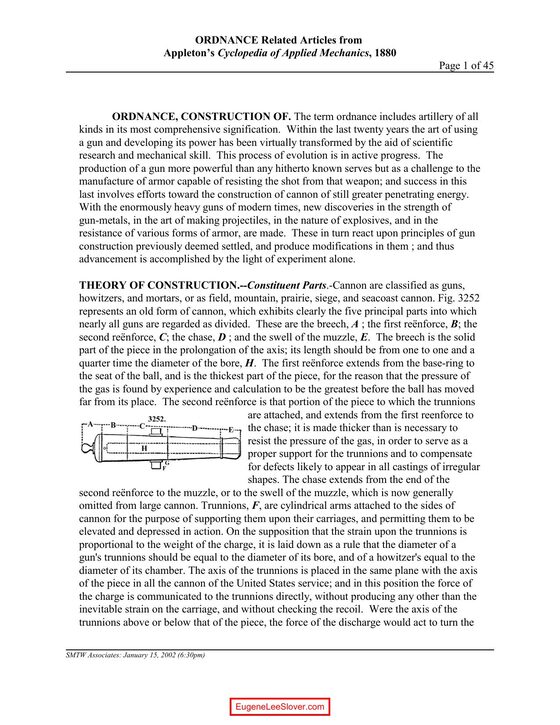
| ORDNANCE, CONSTRUCTION OF — theory of construction; the constituent parts of a cannon (Fig. 3252) | 1 |
| Length of bore — why the long culverins were cut down | 2 |
| Strains in the gun, and the testing of guns | 3 |
| Rifling — forms of groove and degree of twist | 4 |
| Forms of cannon — muzzle-loading smooth-bores | 5 |
| Muzzle-loading rifles — the Parrott gun (Fig. 3259) and the Armstrong gun | 6 |
| The Armstrong 100-ton gun built for the Italian armored ships | 7 |
| Table — summary of experiments with the 100-ton gun | 8 |
| The Woolwich gun (Fig. 3264) — the Frazer modification, and the 81-ton gun | 9 |
| II. Breech-loading rifles — and why England had not adopted them | 10 |
| The Krupp gun (Figs. 3265–3266) — steel hoops shrunk on with initial tension | 11 |
| The Krupp breech mechanism, and its polygroove rifling | 12 |
| The Dean-Uchatius bronze-steel gun | 13 |
| Enlarging the bore by mandrel under hydraulic pressure (Fig. 3270) | 14 |
| Howitzers | 15 |
| Mortars; and performances of heavy guns (Fig. 3275, compiled by Major S. C. Lyford) | 16 |
| Targets C, D and E — the armored ships of England, France, Russia, Germany, Austria, Turkey and Italy | 17 |
| Full-page diagram — Fig. 3275, penetration against the standard targets | 18 |
| Penetrating energy of foreign ordnance from 70 to 2,000 yards (Fig. 3276) | 19 |
| Tables — ordnance of the United States land service: sea-coast, siege and field pieces | 20 |
| Table — experimental guns built by the Ordnance Bureau | 21 |
| Tables — naval and foreign ordnance compared | 22 |
| Table — German, French and Russian breech-loading guns; shells and shell-guns | 23 |
| ORDNANCE — GUN-CARRIAGES — I. Naval carriages; the U.S. Navy pivot-carriage | 24 |
| The broadside Scott carriage (Fig. 3277); Vavasseur's carriage (Fig. 3278) | 25 |
| Turret carriages (Fig. 3279) — the arrangement in a U.S. monitor turret | 26 |
| Lowering guns — disappearing systems | 27 |
| II. Land carriages — United States practice | 28 |
| Krupp's protected non-recoil gun (Fig. 3286) — pivoted at the muzzle in the casemate armor | 29 |
| ORDNANCE — MACHINE-GUNS — mitrailleuses, and the Gatling gun | 30 |
| The Gatling mechanism — the cam-ring developed flat, and the ten locks (Figs. 3289–3290) | 31 |
| Revolving cannon — the Hotchkiss; the Lowell battery-gun; the Taylor machine-gun | 32 |
| Two thousand fragments a minute — the ammunition of the revolving cannon | 33 |
| The loading mechanism, step by step, with the crank in continual motion | 34 |
| Firing trials from a moving vessel — hits per round at 10 knots | 35 |
| Changing the elevation for each barrel automatically (Fig. 3299) | 36 |
| ORDNANCE, MANUFACTURE OF — materials, and the elastic limit of gun-metals | 37 |
| Table — density and tenacity of metals; the Admiralty experiments on gun-metals | 38 |
| Manufacture of cast guns, after Commander R. F. Bradford, U.S.N. | 39 |
| The casting pit, the flask, and setting the core on its spider | 40 |
| Manufacture of built-up guns; and rifling heavy ordnance | 41 |
| Converted guns — the Parsons and Palliser methods of lining a smooth-bore (Fig. 3305) | 42 |
| The U.S. conversion experiments under Lieut.-Col. Silas Crispin (Fig. 3306) — breech insertion beats muzzle insertion | 43 |
About the Scan
This is not a photographic scan of the 1880 book. It is a typeset transcription, made from the Cyclopedia on 15 January 2002 by SMTW Associates, with the original engravings lifted from the pages and set back into the text where they belong — so the figure numbers (3252, 3259, 3264 and the rest) are the Cyclopedia's own. The page footers carry the transcriber's line and the date.
Complete at 45 pages. Viewer page numbers match the page numbers printed in the running head — every page is stamped “Page N of 45” at the top right, and all 45 were checked against the viewer. The original Cyclopedia's own page numbers are not carried over into this transcription, which is why the index above is numbered 1 to 45.
The heaviest illustrations are worth going to directly: the 100-ton gun trials table on page 8, Major Lyford's full-page penetration diagram on page 18, the comparative ordnance tables on pages 20 to 23, and the Gatling cam-ring developed flat on page 31.
The companion article on armor, from the same 1880 Cyclopedia, is on its own page — the other half of the gun-versus-armor argument this article keeps referring to.
Using the viewer: The viewer page numbers match the “Page N of 45” numbers printed at the top of each page.
Use the double caret (») symbol at top right of viewer to adjust scrolling.
⇓ Download the Ordnance Articles PDF — 3.7 MB
✉ Enjoyed This Page?
Get a free email whenever a new page like this goes up — original gun books,
ordnance pamphlets, and wartime film straight from the archive. No spam, unsubscribe any time.
Subscribe for Free →
