
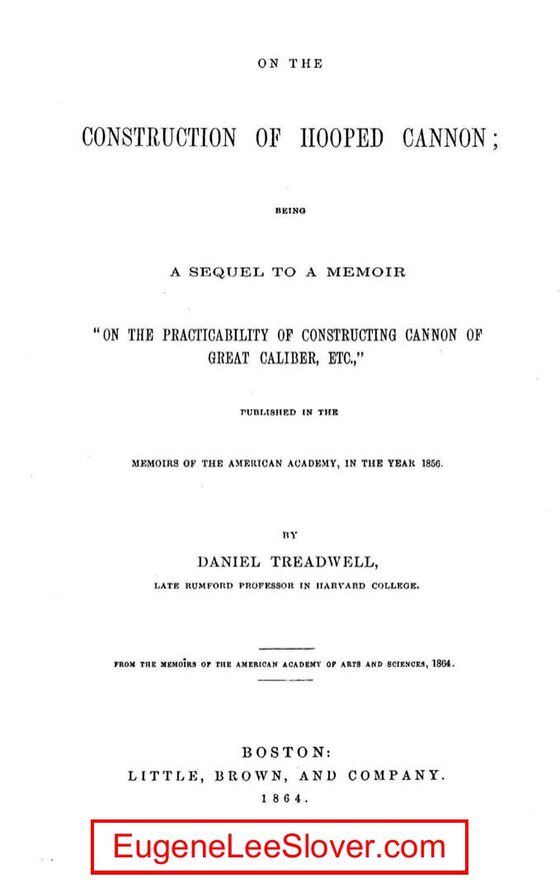
This is Daniel Treadwell’s sequel to his 1856 memoir On the Practicability of Constructing Cannon of Great Caliber, published by Little, Brown of Boston from the Memoirs of the American Academy of Arts and Sciences in 1864 — in the middle of the Civil War, with the argument no longer theoretical. Treadwell opens by conceding that a great improvement had already been made by adopting his principle, and “imperfectly the mechanical form,” and states his purpose plainly: many points in the theory of that construction “remain not only unperfected, but almost unexamined.”
What makes this memoir worth reading a century and a half later is that Treadwell went and measured things. The middle of the paper is a set of tensile experiments on iron and steel wire, done on a rig he describes — a graduated tin plate a foot long, the wire loaded by hand in 40-pound steps to 480 pounds and past it — to establish where elastic extension ends and permanent stretch begins, and what heating does to the elasticity of a drawn wire. He reproduces the results as figures rather than tables. From those numbers he draws the two conclusions the rest of the argument stands on: that iron in the hard drawn state has a wide range of purely elastic extension, and that heating a hoop to a red heat, as is necessary to shrink it on, will not impair its elasticity.
He then applies the results. There is a computation of a hooped gun of specified dimensions — the compression the hoops put into the body at rest, what happens when the powder pressure is added, and how the load divides between hoops and body. There is a section on why hollow cast-iron cylinders fail under internal pressure, and the observation that a bursting bronze gun always begins to fail on the outside. And the last third of the memoir is shop practice, which is the part an ordnance man will recognize: the form of a six-threaded screw for joining hoops (Figure 6), how the hoop is to be hammered, and that the last part of the hammering is to be done after the hoop has gone cold.
Treadwell’s principle — a thin inner body under initial compression from shrunk-on outer layers — is the basic principle of built-up gun construction, and it survived into every large naval and seacoast gun that followed. Lissak derives it formally in Chapter VI of Ordnance and Gunnery; Ruggles applies it to guns wound with wire rather than hooped with rings.
What Is in the Memoir
Like its predecessor, this memoir runs continuously — no chapters, no printed table of contents. This is a page-by-page index built from the text itself, so you can go straight to the experiments, the computation or the shop practice.
Every line in this table is a link. Click one and the reader below jumps to that page.
About the Scan
Complete at 40 pages, from the title page through the closing remarks. Viewer page numbers match the printed page numbers throughout — page 1 is the title page and page 3 is the opening of the memoir. The figures are worth finding: the wire experiment plots are on pages 14, 15 and 19, the threaded-hoop drawing on page 29, and Figures 6–9 on pages 32 and 34.
Using the viewer: The viewer page numbers match the printed page numbers throughout. Use the double caret (») symbol at top right of viewer to adjust scrolling.
⇓ Download On the Construction of Hooped Cannon PDF — 4.0 MB