
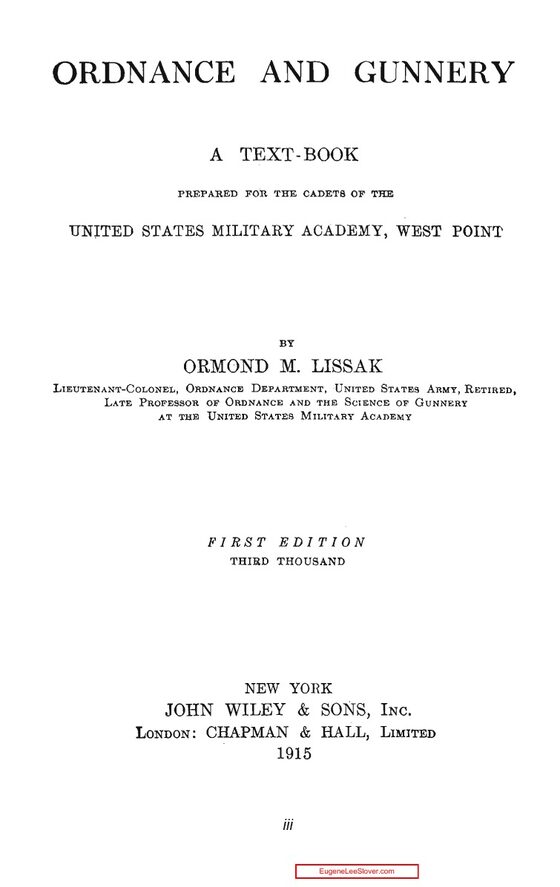
Ordnance and Gunnery by Ormond M. Lissak, Lieutenant-Colonel, Ordnance Department, United States Army (retired), late Professor of Ordnance and the Science of Gunnery at the United States Military Academy, was published by John Wiley & Sons of New York in 1915 — first edition, third thousand. It is the complete West Point ordnance course of its generation, written for cadets and set out in 604 pages with some seventy inserted plates, folding diagrams and tables.
Lissak opens the preface with the observation that gives the book its urgency: “The material of war has undergone greater changes in the past thirty years than in the previous hundreds of years since the introduction of gunpowder.” He was writing in 1915. Smokeless powder was barely twenty years old, wire-wound guns were still an open question, the disappearing carriage was the state of the seacoast art, and the submarine torpedo boat closes the book as a novelty. Everything in these pages was current equipment when it was printed.
The text is unusual for its period in how much of it is worked arithmetic. Lissak sets out the theory — Lamé’s laws for stresses in a closed cylinder, Noble and Abel’s constants, Ingalls’ interior ballistic formulas, Mayevski’s law of air resistance — and then works complete numbered problems through to a numerical answer, so that a cadet could follow the method rather than take the result on faith. Two contributions are his own or new to English: a simplification of Clavarino’s gun construction formulas, which materially shortens the labor of applying them, and the first English-language treatment of the theoretical determination of the results of an explosion — quantity of heat, volume of the gases, temperature and pressure.
This is an Army text, and the difference from its Navy counterpart is worth knowing before you read it. Where Fullam and Hart’s Text-book of Ordnance and Gunnery was written for midshipmen and is organized around the gun as it is mounted and fought in a ship, Lissak is organized around the gun as a piece of engineering, and around the artillery of the land service — mountain, field, siege and seacoast. The ballistics, the metallurgy, the gun construction formulas, the armor chapter and the projectile chapter are common ground, and a great deal of what the Navy taught in its own ordnance courses for the next thirty years descends from material of exactly this kind.
What Is in the Book
Every line in this table is a link. Click a chapter and the reader below jumps to it.
| Chapter | Subject | Page |
|---|---|---|
| I | Gunpowders | 1 |
| II | Measurement of Velocities and Pressures | 32 |
| III | Interior Ballistics | 49 |
| IV | Explosives | 136 |
| V | Metals Used in Ordnance Construction | 163 |
| VI | Guns — elastic strength, construction, rifling, breech mechanisms | 188 |
| VII | Recoil and Recoil Brakes | 274 |
| VIII | Artillery of the United States Land Service | 304 |
| IX | Exterior Ballistics | 357 |
| — | Appendix to Chapter IX — The Use of Table II, Ingalls’ Ballistic Tables | 421 |
| X | Projectiles | 438 |
| XI | Armor | 466 |
| XII | Primers and Fuses for Cannon | 477 |
| XIII | Sights | 505 |
| XIV | Range and Position Finding | 525 |
| XV | Small Arms and their Ammunition | 541 |
| XVI | Machine Guns | 564 |
| XVII | Submarine Mines and Torpedoes. Submarine Torpedo Boats | 576 |
| — | Tables I–VI — X functions, heats of formation, specific heats, densities, atomic weights, metric conversion | 596 |
Some chapters repay a visit on their own. Chapter VI is the longest in the book and the most technical: it derives the elastic strength of a built-up gun from first principles, then follows a gun through the shop — gun lathe, boring and turning mill, shrinking the hoops on, rifling the bore — and finishes on breech mechanisms, including the slotted-screw and Welin blocks and the De Bange obturator that made them gas-tight. Chapter VIII is a catalogue of the 1915 United States land service: the 3-inch field gun, the 4.7-inch siege gun, the 6-inch siege howitzer, the 12-inch disappearing carriage of 1901 and the 12-inch mortar carriages. Chapter XVII closes the book with Confederate mines, the Sims-Edison, Whitehead, Bliss-Leavitt and Howell torpedoes, and the Holland and Lake submarine torpedo boats.
About the Scan
This copy is presented complete, front matter through the final conversion table. The original book carries a large number of inserted plates and folding diagrams that stand outside the printed page sequence — they are numbered 14a, 166a, 184a–184d, 242a and so on, sitting between the numbered leaves. All of them are in this scan in their proper places, which is why the viewer runs to 675 leaves for a 604-page book. The table of contents below gives the printed book page for every entry and jumps the viewer to the leaf it actually falls on.
Using the viewer: Use the Full Table of Contents button (bottom-right) to jump to any chapter, major section or table. Use the double caret (») symbol at top right of viewer to adjust scrolling. This is a large file — give it a moment to open.