
This is the other half of the argument. The ordnance articles from the same 1880 Cyclopedia describe guns built to defeat armor; this article describes the armor built to stop them, and the two were written to be read together. It opens by stating the problem exactly: how best to protect a ship “against the effects of the shock of the enormous projectiles which, thrown with an extraordinary energy from heavy guns of large calibre, will have to be resisted in future naval engagements.”
What follows is a survey of nearly twenty years of plate trials, and the conclusions are stated as numbered findings rather than opinions — that tough wrought iron of high elasticity beats iron of the highest tensile strength; that resistance goes roughly as the square of the plate thickness; that rigid backing preserves the face while elastic backing protects the structure behind it. Then the interesting part: the moment steel and compound plates arrive, the reasoning changes. A compact steel plate does not tear like fibrous iron — instead it breaks up the point of the shot, and the projectile destroys itself against the plate. The article records that at Spezia, against the 100-ton gun, this held.
The last third is applied naval architecture, ship by ship: the armored citadel and its bulkheads, the Alexandra with her belt carried down to the ram, the Nelson and Northampton and their 181-foot water-line belt, and the Russian circular ironclads Admiral Popoff and Novgorod. It closes with the things that were tried and failed — India-rubber backing, and a boiler packed with wool and shot at with a 68-pounder at Shoeburyness in 1864.
What Is in the Article
Every line in this table is a link. Click one and the reader below jumps to that page. The page column gives the viewer page first, and the Cyclopedia's own printed page in brackets.
About the Scan
Like the ordnance articles, this is a typeset transcription rather than a photographic scan — the original engravings are set back into the text, so the figure numbers (239, 241, 242, 244, 245) are the Cyclopedia's own. It carries a small number of bracketed Notes to the Electronic Edition where the transcriber found an apparent error in the 1880 text and chose to flag it rather than silently correct it; one is at page 7 and another at page 8.
The file runs 15 leaves and reproduces Cyclopedia pages 146 through 159. The mapping is not quite one to one: leaf 1 is page 146, leaf 2 is the inserted plate facing page 146, and from leaf 3 onward the printed page number is the viewer page plus 144 — leaf 3 is page 147, leaf 15 is page 159. Every leaf was checked against the running head printed on it. The index above gives both numbers.
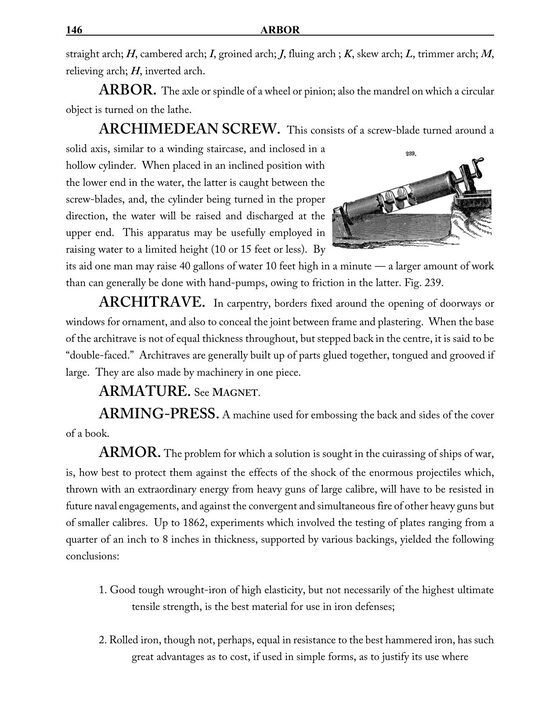
Page 146 begins part-way down the column, so the article is preceded by the tail of the preceding entries — arbor, Archimedean screw, architrave, armature and arming-press. That is how the page fell in the book, and it has been left as printed.
Using the viewer: Viewer page 1 is Cyclopedia page 146; from viewer page 3 on, add 144 to get the printed page number. Use the double caret (») symbol at top right of viewer to adjust scrolling.