
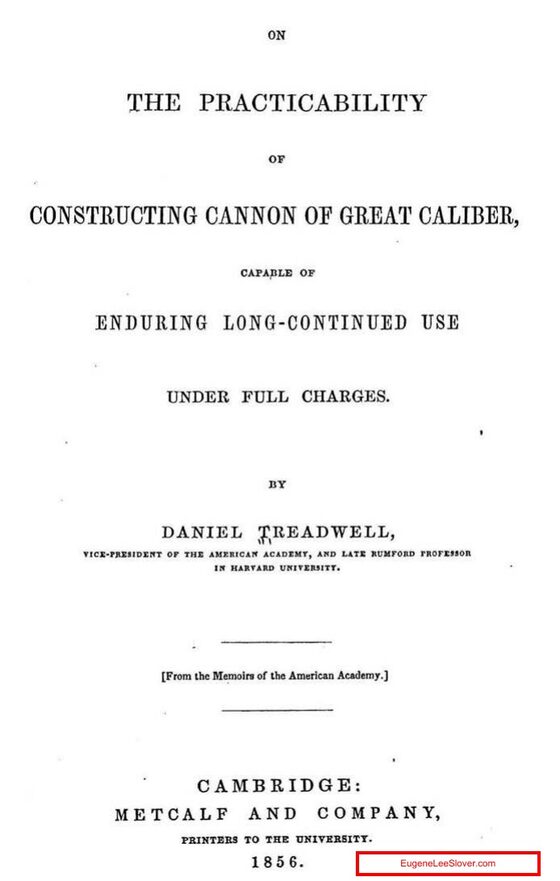
Daniel Treadwell (1791–1872) was Rumford Professor at Harvard and Vice-President of the American Academy of Arts and Sciences. He was not an ordnance officer. He was an inventor and a mechanician — he had built a power printing press and a machine for spinning hemp — and in 1845 he began publishing on a question the artillery services of the world could not answer: why do big guns burst?
This memoir, read to the Academy and printed in its Memoirs in 1856, is the full statement of his case. Treadwell’s argument is that the failure is not one of material but of geometry, and it rests on a fact that was genuinely counter-intuitive at the time: in a thick cylinder under internal pressure, the outer metal does almost nothing. Because the material stretches, the inside of the wall is strained to its limit and fails long before the outside has taken up any appreciable share of the load. Making a gun thicker therefore adds weight, cost and casting defects while adding very little strength — and the largest guns, which need the most strength, are exactly the ones where the effect is worst.
His answer is the built-up gun: a comparatively thin inner body, surrounded by rings or hoops of wrought iron shrunk on so that they squeeze the body inward while the gun is at rest. The powder pressure then has to overcome that initial compression before it begins to stretch the bore at all, and the hoops and the body carry the load together. Treadwell works through the arithmetic of a specific example — a cast-iron body with two 3-inch wrought-iron hoops — and takes the question of the strength of the material, the velocity of the explosion, and the pressure at the bottom of the bore each in turn.
He was right, and the principle in this memoir is the one every large gun in this archive is built on. Sixty years later Lissak would state it as the basic principle of gun construction and derive it from Lamé’s laws, and Ruggles would extend it to guns wrapped in wire instead of hoops. Treadwell got there first, from a professorship at Harvard, using arithmetic and a tensile-testing rig, and he spent much of the rest of his life in litigation over the patents.
Eight years after this memoir Treadwell published a sequel taking the theory further and describing exactly how the hoops should be forged, threaded and shrunk on: On the Construction of Hooped Cannon (1864). Read this one first.
What Is in the Memoir
The memoir runs continuously, with no chapters and no printed table of contents. This is a page-by-page index built from the text itself, so you can go straight to the part of the argument you want.
Every line in this table is a link. Click one and the reader below jumps to that page.
About the Scan
This is the offprint from the Memoirs of the American Academy, printed at Cambridge by Metcalf and Company, complete at 35 pages. The title page carries no date of its own; the 1856 date is the one Treadwell himself gives for this memoir on the title page of the 1864 sequel. Viewer page numbers match the printed page numbers one for one throughout. Figures 1 and 2, the diagrams of the cylinder wall under internal pressure that carry the central argument, are on page 16.
Using the viewer: The viewer page numbers match the printed page numbers throughout. Use the double caret (») symbol at top right of viewer to adjust scrolling.