

Representative depth charges — the cylindrical and teardrop types side by side.
A depth charge is a thin-walled container filled with a heavy charge of explosive, dropped or thrown into the water and set to explode at a predetermined depth. It is the classic shipboard antisubmarine weapon of both World Wars — carried by destroyers, destroyer escorts, subchasers, PT boats and other vessels likely to engage submarines.
How does a depth charge sink a submarine? Not by hitting it. A direct hit is extremely difficult, because the exact position of a submerged submarine is usually not known. Instead the charge relies on the percussive wave — the pressure shock the explosion drives through the surrounding water, which can crush or spring the hull plating of the target. Neither the hydrostatic nor the influence exploder depends on contact with the submarine at all.
How close does it have to be? The effective radius depends on the structural strength of the vessel attacked, and no fixed figure holds for every case. As a working guide, a 600-pound charge may cause moderate damage at 80 feet but must explode within about 30 feet to be fatal; a 300-pound charge may prove fatal within 20 feet. Note that doubling the weight of the charge does not double the effective radius — which is why charges are dropped in patterns rather than singly.
| Mark | Shape | Filler | Dimensions | Notes |
|---|---|---|---|---|
| Mark 6 | Cylindrical | 300 lb TNT | About 28 in. long, 18 in. diameter | The classic WWII charge; later used largely for training |
| Mark 7 | Cylindrical | 600 lb TNT | Larger than the Mark 6 | Obsolete |
| Mark 9 | Teardrop, weighted nose | About 200 lb TNT or HBX | Same overall dimensions as the 300-lb cylindrical charge | Faster sinking rate, improved underwater trajectory |
| Mark 14 | Teardrop, weighted nose | About 200 lb TNT or HBX | Same overall dimensions as the 300-lb cylindrical charge | Later teardrop type |
The teardrop shape and weighted nose of the Mark 9 and Mark 14 were adopted to increase the sinking rate and give a more predictable underwater trajectory — less time in the water means less time for the target to manoeuvre away from the set depth.
- Depth setting — older charges
- Hydrostatic exploder mechanism, graduated to 600 or 1,000 feet depending on mod
- Depth setting — later charges
- Influence-type firing mechanism
- Kill mechanism
- Percussive (pressure) wave — no contact with the target required
- Launched from
- Stern release tracks · Beam projectors (K-gun) · Aircraft (as depth bombs)
- Internal components
- Sheet-metal case and central tube · Cast TNT or HBX filler · Booster and hydrostatic booster extender · Detonator
- Carried by
- Destroyers · Destroyer escorts · Subchasers · PT boats
Charges are released in a pattern — several in rapid succession, spread in depth, width and length — to raise the probability of a kill. The pattern is formed by rolling some charges off release gear on the stern while firing others abeam from projectors, with the depth settings made on each charge before launching. Because the charges are never thrown far from the attacking vessel, the ship must be making enough speed to be clear of the violent effect it has just produced; computing that speed is part of the antisubmarine fire control problem.
Release tracks. Inclined rails on which the charges rest, with mechanical detents releasing one charge at a time. A typical track holds eight Mark 6 charges. The charges roll aft under their own weight against the after detents; operating the release lever drops the after detents while the forward detents rise to hold the rest steady. The track control unit is connected hydraulically to a control position on the bridge, so charges can be released remotely. Four tracks carry letter rather than mark designations — types A and C hold a single charge, types B and D hold two — and are intended primarily for small vessels and motor boats.
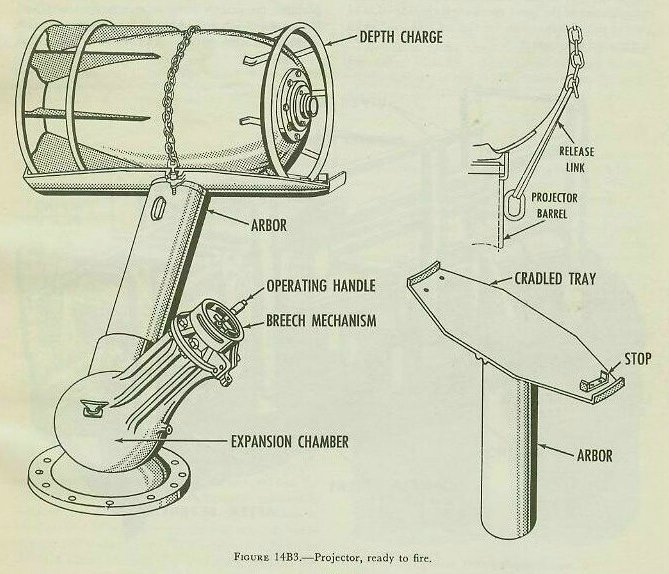
Depth Charge Projector Mark 6 Mod 1 — the K-gun — with its arbor.
The K-gun. The Depth Charge Projector Mark 6 Mod 1, universally called the K-gun, launches the 300-pound cylindrical charge or the 200-pound teardrop charge out to the flank of the ship. It is a smooth-bore barrel attached to an expansion chamber fitted with a breech mechanism; the breech plug is an interrupted-screw type housing a firing mechanism that allows local percussion firing by lanyard or electrical firing from the bridge. The projector is permanently secured to the ship and cannot be trained or elevated — range is varied instead by changing the weight of the impulse charge.
Impulse charges are spherohexagonal black powder assembled in 3-inch cases similar to torpedo impulse charges. Three standard weights give ranges of 50, 75 and 120 yards with the Mark 6 depth charge, or 60, 90 and 150 yards with the Mark 9 and Mark 14.
What is a depth charge arbor? The arbor is the steel stem that carries the charge out of the projector — the propellant gas acts against the base of the arbor rather than against the charge itself. The arbor used with a cylindrical charge stays attached after firing; the arbor used with a teardrop charge detaches after firing, so the streamlined shape of the charge can do its work on the way down.
- OP-831 — Depth Charge Projector Mark 6 (First Revision, July 1944) — the Bureau of Ordnance manual for the Mod 1 and Mod 2 projectors: description, operation and maintenance, replacing the older Y-gun type projector
- Depth Charges — Full Chapter Text (Ch. 14B) — charge types, release gear, projectors, depth-charge operation, pistols and exploder mechanisms in full
Depth bomb vs. depth charge: a depth bomb is simply a depth charge designed to be dropped from an aircraft. Depth bombs were among the major antisubmarine weapons of World War II, delivered by toss bombing, glide bombing, or low-altitude release. The case is comparatively light — the explosive filler is about 70 percent of the assembled weight — and the nose is flat, to reduce the danger of ricochet at small entrance angles.
Carried in aircraft with selective arming, a depth bomb normally takes two fuzes: an impact-type nose fuze with a flat arming vane for surface or land targets, and a hydrostatic tail fuze for submerged submarines. The tail fuze offers five depth settings from 25 to 125 feet, normally made before take-off. When the tail fuze is dropped armed, the nose fuze must be dropped safe — otherwise the bomb detonates on water entry. Aircraft without selective arming use the tail fuze only.
- Depth Bombs — Description, Fuzing & Damage (Ch. 14C) — includes the HBX-loaded Depth Bomb Mark 54 Mod 1 and the hydrostatic tail fuze
Depth charges are dropped or fired abeam, which means the attacking ship loses sonar contact as it passes over the target. Ahead-throwing weapons solve that problem by putting a pattern of charges in the water in front of the ship while contact is still held.
The 7.2-inch rocket and Rocket Launcher Mark 20 were the Navy's first thrown antisubmarine missile. Two launchers mounted on the forecastle fire a pattern of eight charges. Because the charge is a true rocket there is negligible thrust against the deck, which makes the weapon suitable for craft as small as PCs and SCs. The rocket head carries a contact fuze, so a direct hit is required — but when a hit is obtained, even the small charge can be lethal.
The 7.2-inch projector charge looks similar but is not a rocket: it is driven by an impulse charge of smokeless powder fired electrically by a primer in the base of the cartridge case, and carries 30 pounds of TNT. Its fuze arms during flight and functions on impact only. As the missile leaves the projector, the cartridge case base falls to the deck.
The 7.2-inch Projector Mark 10 — the hedgehog — throws a pattern of 24 charges ahead of the attacking vessel. The missiles are loaded onto cylindrical bars called spigots, attached to cradles that swing about a fore-and-aft axis through a roll-correction gear assembly, allowing the pattern to be compensated for roll and led onto the target. The charges describe an elliptical pattern of roughly 140 by 120 feet. The Mark 10 and its 7.2-inch missile replaced the Mark 20 rocket launcher on destroyer escorts and larger vessels; because the Mark 10 is much heavier and its deck thrust considerable, the Mark 20 remained in service on small craft.
- Throwing Weapons — 7.2-Inch Rocket, Projector Charge, Mark 10 & Mark 11 (Ch. 14D) — launchers, spigots, cradles, roll correction and pattern geometry
A depth charge is only as good as the solution that places it. Locating a submerged submarine, holding contact through the attack, and computing when to fire is the antisubmarine fire control problem — sonar, the tactical range recorder, the attack plotter, and depth-determining equipment.
- Antisubmarine Warfare — Fire Control & Sonar (Ch. 28) — the antisubmarine fire control problem, underwater detection and the limitations of sonar, QHBa scanning sonar, controlling the attack with the tactical range recorder and attack plotter, OKA-1 sonar-resolving equipment, and depth-determining sonar
- Antisubmarine Warfare — General (Ch. 14A) — the ASW problem and the weapons available to solve it
Where charges attack the submarine, nets and booms deny it the approach. Modern harbor defense became a problem of defending against the torpedo — either by preventing the vessel carrying it from reaching firing range, or by stopping the torpedo itself. There are five classes:
- Type S net — antisubmarine, blocks passage or reveals a submarine that breaks through
- Type I (Indicator) net — antisubmarine
- Type T net — antitorpedo; the ISP (Individual Ship Protection) variation surrounds a single valuable ship or floating dry dock
- Type B boom — antimotorboat
- Rigid obstructions
- Nets and Booms — Harbor Defense (Ch. 14E) — the five classes in full, net construction, and individual ship protection
- Naval Mines — Complete Guide — the other underwater weapon: classification, firing mechanisms, minelaying, countermeasures and identification of 67 mine types
- OP 1507 — Japanese Underwater Ordnance: Mines, Depth Charges & Torpedoes — U.S. Navy intelligence summary of Japanese depth charges with identification data and handling precautions
- The Battle of the Atlantic — the campaign these weapons were built to win
- Bottling Up the U-Boats — wartime account of the antisubmarine effort
- The Destroyer Escort Program — the ships built specifically to carry these weapons
- 800 DE's To Be Built — the wartime escort construction program
- ▶ USS Cassin Young DD-793 Weapons — depth charge racks and projectors aboard a preserved Fletcher-class destroyer
- Submarines Index — the target's side of the problem