
Chapter 1 of NavPers 10797-A, Naval Ordnance and Gunnery, Volume 1 provides the foundational definitions and organizational context for the study of naval weapons. It defines ordnance and gunnery, describes the responsibilities of the Bureau of Ordnance and the Department of Defense, explains how the gunnery department is organized aboard ship, and outlines the purpose and scope of the text that follows.
A. General
1A1. Definition of terms
This text is concerned with the study of Naval Ordnance and Gunnery. Together, the terms "ordnance" and "gunnery" embrace weapons and their use.
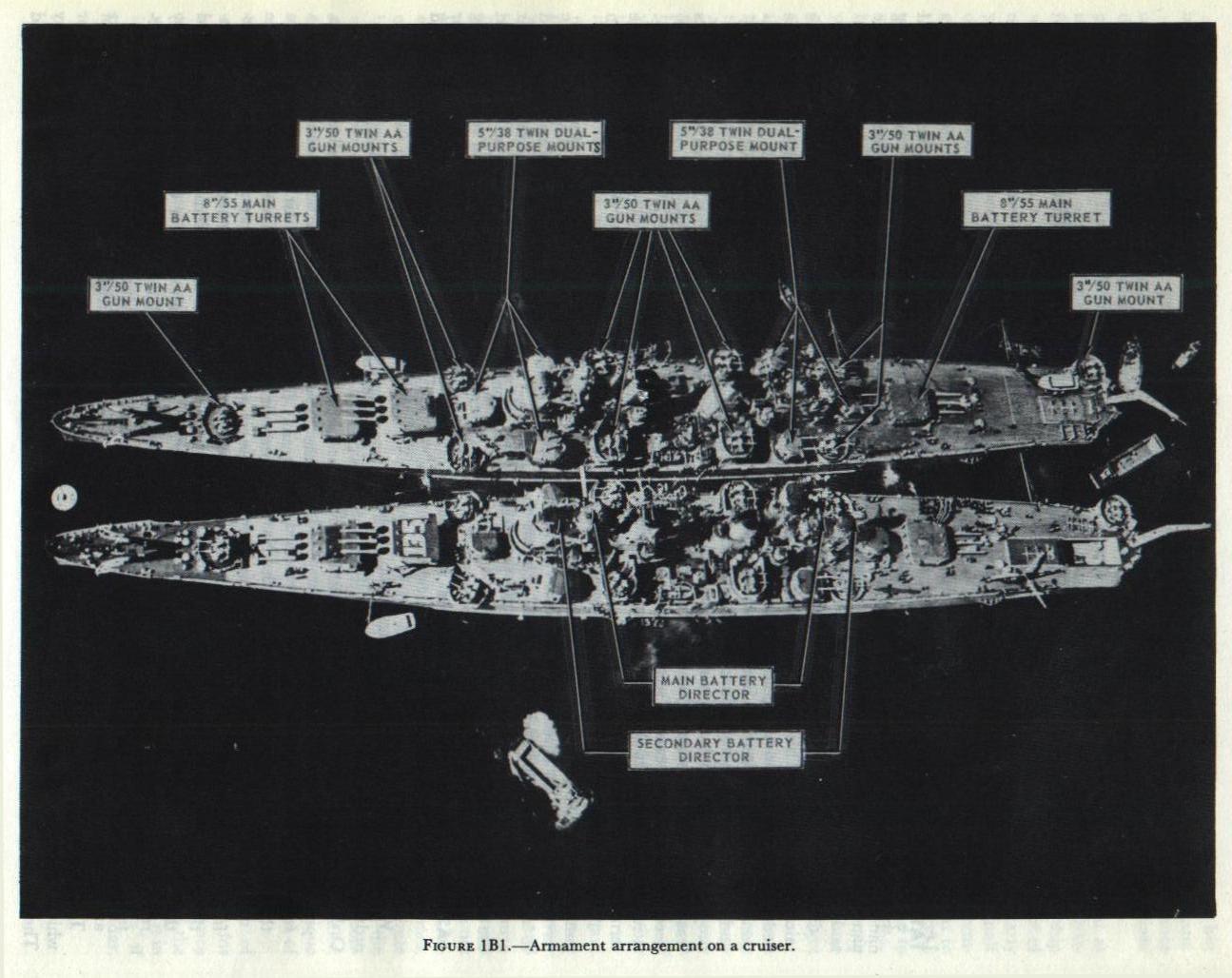
Ordnance comprises the physical equipment pertaining to weapons. This equipment is further classified as explosive ordnance, including such elements as gun ammunition, torpedoes, mines, bombs, rockets, and the like, and inert ordnance, which includes projecting devices (such as guns, launchers, and release gear), protective armor, and all the equipment needed to operate and control weapons. Aboard ship it refers to all elements that come under the general term "ship's armament."
Traditionally, gunnery is the art and science of using guns. However, in the sense used in this book, the term is broadened in agreement with modern usage, to include the operation and control of all elements of armament. Gunnery is concerned with the practical use of ordnance.
1A2. Navy Department responsibilities for ordnance and gunnery
Within the Navy Department, the responsibility for ordnance material rests chiefly in the Bureau of Ordnance. As defined by Navy Regulations, 1948:
"The Bureau of Ordnance shall be responsible for the following, except as otherwise prescribed in these regulations or by the Secretary of the Navy:
"The design, development, procurement, manufacture, distribution, maintenance, repair, alteration, and material effectiveness of naval ordnance; the research therein; and all pertinent functions relating thereto, including the control of storage and terminal facilities for, and the storage and issue of, ammunition and ammunition details."
The Bureau of Ordnance maintains field activities which contribute to the performance of its mission. These field activities include research activities, such as the Naval Ordnance Laboratory and the Naval Proving Ground, inspection facilities, manufacturing plants, such as the Naval Powder Factory and the Naval Gun Factory, and various storage and distribution facilities.
The operational use of weapons is controlled by the Chief of Naval Operations through the fleet and force commanders, with appropriate liaison with the technical bureaus concerned. This control includes cognizance over operational and team training.
The Bureau of Ships and the Bureau of Aeronautics are concerned with the problems of design caused by the installation of ordnance on ships and aircraft, respectively, and their plans are coordinated with those of the Bureau of Ordnance in the satisfactory solution of these problems.
The Bureau of Naval Personnel is charged with the responsibilities for training both officers and enlisted personnel as individuals in the performance of their professional duties, except as otherwise assigned, and for the procurement, distribution, and record keeping of all personnel of the Navy. Training programs for all gunnery personnel, except aviation, are maintained by this Bureau.
1A3. Department of Defense responsibilities
In ordnance and gunnery, as in all other matters, the Navy functions not alone but as one member of a team. The Army and the Air Force both maintain ordnance establishments and both are interested in the art of gunnery. Ordnance equipment is usually developed by and procured by the service primarily interested. Doubtful or borderline cases are assigned to one service or another; for development work, by the Research and Development Board; for manufacture and procurement, by the Munitions Board.
There are hundreds of cases in which an item of ordnance equipment is used by all three services. For instance, the Navy and the Air Force both use Army rifles and pistols; the Air Force carries Navy mines, and the Navy, Air Force bombs; the Army uses some Navy projectile fuzes, and the Navy, several Army rocket fuzes. When one service develops and procures a device for another, it usually furnishes all appropriate spare parts, tools, and instructional material as well.
Neither the Marine Corps nor the Coast Guard maintains ordnance departments. Each of these services has upon occasion developed and procured highly specialized equipment for itself; ordinarily, however, they are dependent for their ordnance upon the Army, Navy, and Air Force.
1A4. Function of the gunnery department aboard ship
The requirements for battle are the basis for the organization of the combatant ship. Under Navy Regulations, 1948, in ships whose offensive characteristics are primarily related to ordnance or aircraft, one of the major command departments is the gunnery department, headed by the gunnery officer. He is concerned primarily with the maintenance, upkeep, and operation of all the equipment in the ship's armament (with the exception of that of the ship's aircraft in ships having an air department). His department is organized into divisions, the number and function of which depend upon the class and purpose of the ship.
In auxiliary vessels, and certain other types whose offensive characteristics are not primarily related to ordnance and aircraft, gunnery is a secondary function of the deck department, which is headed by the first lieutenant. In this case such ordnance equipment as is carried is the responsibility of the first lieutenant, usually exercised through a gunnery officer who is one of his assistants.
B. Scope of the Text
1B1. General
This text is planned to satisfy several needs. It is intended as a training text for midshipmen and officer candidates. It will be useful to gunnery department officer personnel as a reference and as a guide in the gunnery aspects of shipboard organization. And it is intended to serve as a convenient reference for all officers, other than those in the gunnery department, who have occasion to deal with any aspect of United States naval weapons — fiscal, supply, passive, defensive, etc.
This text is not intended to supersede or supplant official publications of the Chief of Naval Operations, the Bureau of Ordnance, or the Bureau of Naval Personnel with regard to doctrine, weapons and ammunition, shipboard organization, or shipboard operations. The reader is referred to official publications of these authorities for instructions on these matters. This text will, however, serve as an introductory guide to the official publications on these matters.

1B2. Presentation of the subject
It is difficult to present a clear understanding of the structure of ordnance mechanisms without some consideration of their operational use. Similarly, the successful study of gunnery depends upon a thorough understanding of the weapons and instruments used. In this book a compromise is effected: Volume 1 concentrates upon the study of weapons, with minimum reference to control, while Volume 2 assumes knowledge of the first part and is concerned with fire control.
Emphasis has been placed upon functional operation of basic systems rather than upon the details of a wide variety of individual instruments. This book was not written for the maintenance man or the repair technician. Ordnance Pamphlets are available for all equipment discussed in this text and should be consulted when more detailed information is required.
1B3. Naval weapons
The weapons to be discussed in the first part of the book include:
Guns. A gun typically consists of a tube, closed at one end, from which a projectile is fired by the burning in an enclosed space of a propellent charge. Guns are general-purpose weapons used against ships on the surface, aircraft, shore installations, and personnel.
Rockets. The rocket is a self-propelled weapon whose absence of recoil makes it particularly suitable for firing from small craft or aircraft.
Guided missiles. These are new weapons under current development. They may travel great distances with heavy loads, are self-propelled, and contain a mechanism capable of directing their own flight.
Torpedoes. A torpedo is a self-propelled underwater missile used against ships.
Mines. Mines are typically static weapons used to hinder enemy operations.
Depth charges. These are antisubmarine weapons which are exploded at a set depth or by proximity to a submarine.
Bombs. The term bombs covers all missiles dropped from aircraft except torpedoes, mines, and guided missiles.
Chemicals. This term is used to describe a variety of solids and gases which can be fired in projectiles from guns or mortars or dropped from aircraft. In World War II they were used chiefly for screening and as incendiaries.
1B4. Ballistics
Ballistics is the science of projectile motion. It falls naturally into two aspects: interior ballistics, which treats of the motion of the projectile within the bore of the gun, and exterior ballistics, which considers the action of the projectile in flight.
Each of these fields is the subject of careful and detailed study by specialists. Their findings are of enormous importance in gun design and in the development of fire-control instruments. A general understanding of ballistics is essential to the naval officer afloat, so that he may achieve the best results with his ordnance equipment.
1B5. Fire control
The practical application of exterior ballistics, and the methods and devices used to control guns and other weapons are known as fire control. The second part of the book treats of this subject in some detail, but a brief listing of some types of fire control equipment at this point may help the student form a better picture of the ordnance equipment found aboard most ships.
Range finders. Rangefinders are optical instruments used to measure the distance to the target.
Radar. Radar, using electronic means, provides more accurate ranges and, in addition, may measure bearing and elevation of the target.
Directors. Directors are mechanical and electrical instruments which control guns from a remote station. They are usually located at a higher level than the guns to provide greater range and better visibility.
Rangekeepers and computers. Rangekeepers and computers are mechanical and electrical, or electronic, instruments which automatically and continuously compute information needed to direct gunfire.
Stable elements. Stable elements are gyroscopically controlled mechanisms which measure movement of the ship with respect to the horizontal and compensate for the effect of this motion.
Transmission systems. Transmission systems are used to send information from one station to another; for example, to transmit gun orders automatically from the computer to the gun mount.
1B6. Identification of ordnance equipment
Each assembled unit of ordnance equipment is identified by a name, a mark number, a modification number, and a serial number. This information is stamped either on the equipment itself or an attached plate. Whenever a basic change in design is made, a new mark number is assigned. Modification numbers are added when a minor alteration of design has been made. Individual units of identical design have the same name, mark, and modification numbers, but have different serial numbers.
An example will help to illustrate the use of this identification system: Computer Mark 1 Mod 0 is the first computer designed. The Computer Mark 1 Mod 1 is similar to the Computer Mark 1 Mod 0, but differs in some details. Serial numbers are usually assigned on the basis of finished assemblies. The name of a gun includes its caliber, as 5-inch 38 caliber Gun Mark 12 Mod 1.
When the Navy uses items of Army ordnance, the Army nomenclature is retained. In Army nomenclature, M corresponds to Mark, A to Modification; for example, the Carbine M1A1.
In referring to a piece of ordnance, the information required for identification depends upon the circumstances. If reference is made to functions only, the name, mark, and modification will be sufficient. If, however, spare parts are being requested from the Bureau of Ordnance, the serial number may also be necessary.
1B7. Knowledge of material
The operation of much ordnance equipment calls for detailed knowledge. Some details are included in this text, but the officer working with the gear should not be content with the coverage given here.
Shipboard installations can seldom be disassembled for the purpose of instruction, but a young officer should miss no opportunity to observe the disassembly of equipment for repair. At other times, he must study pamphlets, blueprints, ordnance circular letters, and other sources. He should not be satisfied until he is entirely familiar with the equipment assigned to his charge.
This information is essential to the gunnery division officer, not only because of his responsibility for the equipment itself, but also because he is responsible for the training of the enlisted men assigned to him for the operation and maintenance of the equipment. Without this knowledge, he will lack the necessary confidence, and his men will be quick to notice his deficiencies. Of course, much confidence can and must be placed in the senior petty officers, but this does not relieve the division officer of his responsibility.
1B8. Care of material
The Bureau of Ordnance issues complete instruction for proper maintenance of ordnance material. These instructions should always be consulted and followed in detail.
All ordnance material is carefully manufactured, usually to close tolerances. Any careless treatment is likely to damage seriously a valuable piece of equipment, disabling it when it may be needed most. In using any fine apparatus, it is wise to be governed by common sense. The equipment was built to function. If it does not, something is wrong, and physical forcing will cause trouble. Levers, knobs, buttons, and switches should not be touched by a person who does not know what they will do. The Bureau of Ordnance Manual states:
"The permanent damage done in a single day of experimentation by inexperienced personnel has frequently exceeded that which, with proper care, might be expected during the entire normal life of the material."
1B9. Safety precautions
Over a period of many years, various rules have been established to prevent casualty to personnel through carelessness or improper use of equipment. These rules are called Safety Precautions and are published by the Bureau of Ordnance, having the full force of regulations. They have been formulated through actual experience with ordnance, and are revised as needed.
Selected safety precautions are included in appendix A of this book.