
Chapter 31 of Naval Ordnance and Gunnery, Volume 2 — Fire Control is the final chapter of the volume. Consolidated here from the original scanned sub-pages into one illustrated, scrollable page, it is addressed to the junior officer reporting aboard ship to the Gunnery Department. It covers the organization of the Gunnery Department and the duties of the Gunnery Officer and his assistants; the administrative duties of a division officer — training, material maintenance, repairs, alterations, the Current Ship’s Maintenance Project, and the Ordnance History; the sources of ordnance information available to the junior officer; and the conduct and analysis of gunnery exercises.
A. Gunnery Department
31A1. Basic plan of organization
The complement of a ship is composed of such numbers, ranks, and ratings of officers and men as are required to operate the ship most efficiently. A ship’s organization is essentially a war organization, developed on the theory that ships should operate in peacetime with an organization that can be expanded quickly without basic change when the transition to a wartime operating condition becomes necessary. It is based on a grouping of functions and personnel that is intended to reduce to a minimum both the possible overlapping of responsibilities and the duplication of personnel.
This does not imply that administrative organization, even in wartime, is parallel with the battle organization discussed in the preceding chapter. It is necessary for the battle organization to provide for short cuts in order to save time in the transmission of orders. It is also necessary for battle organization to provide for alternative channels to be used in case of casualty. The administrative organization can be rather more formal.
31A2. The Gunnery Department
On board ships whose offensive characteristics are those relating primarily to ordnance or aircraft, the Gunnery Officer heads the Gunnery Department and the First Lieutenant is an assistant to the Gunnery Officer, with direct responsibility for deck seamanship.
On board other ships, the First Lieutenant heads the Deck Department and the Gunnery Officer is an assistant to him.
The functions of the Gunnery Department are as follows:
- Operation, maintenance and repair of armament.
- Launching and recovery of aircraft (on ships without an Air Department).
- Operation and maintenance of assigned electronic equipment.
- Antisubmarine warfare.
- Mine warfare.
- Deck seamanship.
- Operation and upkeep of boats.
- Cleanliness and upkeep of spaces assigned to the Gunnery (or Deck) Department, including ship’s exterior.
- Care and storage of all ammunition.
While the functions of the Gunnery Department are many and varied, it must be remembered that the primary reason for its existence is the armament that the ship carries. This armament must be maintained in a constant state of readiness, and it must be effectively operated to deal destruction or damage to the enemy.
The Gunnery Department divisions are designated First, Second, etc., the lowest numbers being assigned to the division whose responsibilities include maintaining the forward battery of the largest caliber guns assigned to the ship. Numerals are then assigned in ascending order from forward aft, with odd numbers starboard, until all divisions of the main battery have been assigned designators. The process is repeated for batteries of the next smaller caliber guns until all battery divisions have been assigned designators. The next higher number is then assigned the Marine detachment, if one is attached to the ship. The letter “F” is used to designate the Fire Control Division, with a second letter added when more than one fire control division is assigned. Thus “FA” designates the Antiaircraft Fire Control Division and “FM” the Main Battery Fire Control Division. On ships operating aircraft, other than aircraft carriers and seaplane tenders, the Aviation Division is assigned to the Gunnery Department and is designated by the letter “V”. When only one division is assigned to the Gunnery Department, the numeral “1” is used as a designator.
31A3. Duties of the Gunnery Officer
The Gunnery Officer is charged with the supervision and direction of the employment of the ordnance equipment and the equipment associated with deck seamanship. He is responsible for the training, direction, and coordination of personnel assigned to his department. He assists the Executive Officer in the planning and conducting of drills and exercises. He is responsible for ensuring that all the functions of the Gunnery Department listed in article 31A2 are properly performed.
31A4. The Gunnery Officer’s assistants
In addition to the First Lieutenant, the Commanding Officer may assign assistants to the Gunnery Officer, consistent with the type of ship, as indicated below:
- Main Battery Officer.
- Fire Control Officer.
- Air Defense Officer.
- Assistants to the First Lieutenant.
- a. Boatswain.
- Torpedo Officer.
- Mine Warfare Officer.
- Aviation Officer.
- Marine Officer.
- Antisubmarine Warfare Officer.
- CIC Liaison Officer.
- Deck Division Officers.
On major vessels, officers of considerable experience are usually assigned as Main Battery Officer, Fire Control Officer, and Air Defense Officer. Where available, officers of specialized experience are assigned to such positions as Torpedo Officer and Mine Warfare Officer. The Aviation Officer and Marine Officer are, of course, billets limited to special personnel. With these exceptions, however, a junior officer just reporting on board ship may well be assigned to any one of the listed administrative billets. If sufficient experienced personnel is available, the junior officer’s assignment will be as assistant to the occupant of one of these billets.
While a junior officer in the Gunnery Department will have many duties of purely administrative nature such as those discussed in this chapter, his primary concern will be with his gunnery battle station. Again, a wide variety of assignments faces the newly commissioned officer. He may be assigned to any one of the following battle stations, depending upon the type of ship and upon the availability of experienced officer personnel:
- Turret Officer or junior Turret Officer.
- Dual-Purpose Battery Group Control (Director Control) Officer, or Illumination Officer.
- Machine-Gun Battery Group Control Officer.
- Main-Battery Director Officer.
- Assistant Plotting-Room Officer (main or dual-purpose battery).
- Torpedo Control Officer.
- Antisubmarine Battery Officer.
B. Administrative Duties
31B1. General
First of all, the junior gunnery officer will find himself confronted with what appears to be an intricate maze of administrative details. He will have inspections, tests, and checks to be made on various pieces of ordnance equipment; he will have inventories to take and spare parts and gear to order; he will have seemingly endless reports to make; he will have countless little problems within his division which require solution. Moreover, he will have watches to stand, logs to write, and will probably have one or more collateral duties not necessarily related to Gunnery Department work. All this will be in addition to his primary duty of developing and maintaining that part of the ship’s armament for which he is responsible to the highest degree of readiness as regards both personnel and material.
A junior officer assigned to the Gunnery Department will be further assigned to a gunnery division and consequently should be familiar with the duties of a Gunnery Department division officer.
Gunnery Department division officers are governed by Navy Regulations and the Ship’s Organization Book. Division Officer’s Guide contains a summary of what must be accomplished in the organization, training, and direction of a ship’s division, and is a useful guide to the leadership aspect of the division officer’s duties.
In addition to the responsibilities and duties prescribed in Navy Regulations, Gunnery Department officers, under the Gunnery Officer, are responsible for the proper performance of the following functions:
- Ensuring, through a properly conducted training program, that all personnel of the division are properly trained in their duties and ready for action.
- Ensuring that all spaces and equipment assigned to the division are maintained in the required condition of upkeep and cleanliness.
- Ensuring that all division personnel are thoroughly instructed in pertinent safety precautions. This responsibility does not end with the publication of safety precautions; the division officer must also ensure that all safety precautions are carried out both in spirit and to the letter.
- Informing the Gunnery Officer of any conditions in the division that may decrease efficiency of division personnel or equipment, particularly if any ordnance equipment in the division is, for any reason, not ready for battle.
Division officers are assigned additional duties pertaining to the specific assignment of their divisions in the Ship’s Organization Book, or as the Gunnery Officer may see fit. Each junior division officer is required to be thoroughly familiar with all duties, responsibilities, and activities of his division. In addition, each junior division officer is assigned certain specific duties for which he is responsible to the division officer.
31B2. Training
No single function is more important than the training of personnel. The most expensive and best designed equipment is useless unless the men stationed at it know how to maintain and operate it intelligently. Training starts at the lowest level. It must be a continuous, progressive process, objectively designed to produce realistic problems and conditions, and intelligently handled to create and maintain enthusiastic interest.
As one of the duties of the Gunnery Officer is the supervision and direction of the employment of ordnance equipment, so is it the junior officer’s duty to implement this program by proper training of personnel. There are several requisites for an effective training program. The junior officer must be completely familiar with the ordnance equipment for which he is responsible. This includes not only operating procedures, but theory and design characteristics as well. He must ensure that petty officers and key personnel, who will conduct instruction on station, are themselves competent and well informed. The junior officer must carefully appraise his men and assign them stations in accordance with their capabilities, both mental and physical. Frequently, valuable information can be obtained from the service record of each man, which is available in the Executive Officer’s office. A division notebook, which should contain detailed data on each man in the division, as well as the division station bill and battle bill, is invaluable in this instance.
Finally, the junior officer cannot neglect his own training. He must apply himself continually and learn not only his job but the jobs of those who are immediately senior to him. When the time comes for fleeting up, he must be ready. He must also learn how his division fits into the Gunnery Department and in turn how that department functions in the ship’s organization.
31B3. Material maintenance
Just as important as the training of personnel to operate ordnance equipment, is the proper maintenance of that equipment, so that it will be serviceable when needed. Modern ordnance equipment is extremely complex and requires constant check, test, lubrication, and adjustment to keep it in first-class operating condition. Much of this routine, day-to-day, week-to-week work can be called “preventive maintenance”—in other words, attempts to discover and eliminate possible sources of trouble before trouble actually occurs.
The Bureau of Ordnance furnishes, with each ordnance installation, publications which outline maintenance procedures. These publications are readily available, but it is the junior officer’s responsibility to see that the procedures outlined in them are followed by the gunners’ mates and fire control technicians.
Frequently, Type Commanders will issue check-off lists which detail the items of work that are to be done daily, weekly, monthly, etc. As work logs are kept on each piece of ordnance equipment, the junior officer can quickly check the work accomplished each week. He should not, however, be satisfied with paper-work checks. The junior officer should get around his spaces during working hours, find out what his men are doing, what items or pieces of gear are troublesome, and what can be done to overcome the difficulties. He can also learn much about his equipment if he is present while checks, tests, cleaning, and lubrication, are going on.
31B4. Repairs
Casualties will occasionally occur even to the best equipment, thus necessitating repairs. A repair is defined by Navy Regulations as “work necessary to restore a ship or article to serviceable condition without change in design, materials, number, location, or relationship of the component parts.”
Repairs are divided into three classes according to the agency performing them: i. e., ship’s force, repair ship, or naval shipyard. Quite naturally, the extent of repairs that can be accomplished by ship’s force on small ships is limited by a lack of facilities and personnel. A repair ship has more elaborate repair facilities and personnel experienced in repair work, and can accomplish most work not of a major nature. The naval shipyard, of course, is capable of handling any major repair item. An Ordnance Repair Card, such as the one shown in figure 31B1, is used to facilitate the accomplishment of repairs.

The general class “repairs” also includes the “alteration equivalent to repair.” This type of work item includes the substitution of a slightly different article or material for one which must in any case be repaired or replaced as a consequence of damage or wear. The definition of “alteration equivalent to repair” is a very narrow one and should never be used to obtain improved equipment in place of older equipment which is still in usable condition.
31B5. Alterations
An alteration is defined by Navy Regulations as “any change in the hull, machinery, equipment, or fittings which involves a change in design, materials, number, location, or relationship of the component parts of an assembly regardless of whether it is undertaken separately from, or incidental to, or in conjunction with, repairs.” No alteration shall be made to any ship or article on board until specifically authorized by the Bureau concerned.
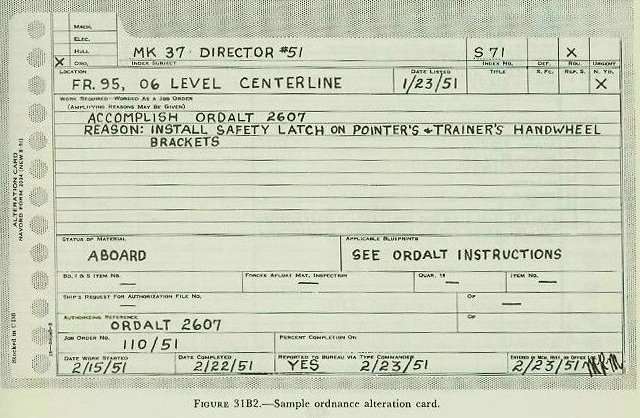
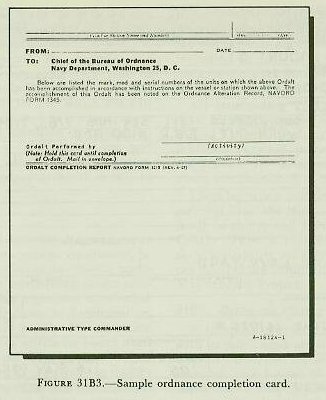
Alterations of such extent as materially to modify the military characteristics of a ship may be authorized only by the Chief of Naval Operations. When so authorized, they are issued by the Bureau of Ordnance or such other technical bureau as may have cognizance of the material concerned, as serially numbered NAVALTS. Other authorized alterations to ordnance equipment are issued by the Bureau of Ordnance as serially numbered ORDALTS. Both NAVALTS and ORDALTS contain complete descriptions of the changes to be accomplished. Information is included on the purpose and priority of the alteration; the agency to perform it; the procurement of material; the disposition of discarded material, if any; the weight change, if any; and all necessary plans, diagrams, and specifications. The information is filed on an Ordnance Alteration Card as shown in figure 31B2. Upon completion of an ORDALT, an Ordnance Completion Card (fig. 31B3) is forwarded to the proper commands.
31B6. Current Ship’s Maintenance Project
In order to have an accurate, up-to-date picture of all outstanding repairs and alterations, each department on board ship maintains a Current Ship’s Maintenance Project (CSMP). Separate files are maintained for repairs and alterations.
The junior gunnery officer should become familiar with the CSMP as soon as possible, and see that entries pertaining to equipment for which he is responsible are promptly made. Whenever a piece of equipment requires repair, a complete brief of the existing condition should be drawn up, including an analysis of the deficiency and an estimate of the work necessary to restore the article to serviceable condition.
All outstanding applicable alterations are also listed in the Alteration and Improvement Program (A and I Program) which serves as a ready summary for administration purposes. This program does not include the same amount of technical detail about the alterations as does the CSMP.
Likewise, when authorizations for alterations are received from the Bureau, prompt entry should be made in the A and I Program and the alteration CSMP. Thus, when a ship is scheduled for repair-ship availability or shipyard overhaul, work lists can be quickly compiled from the Current Ship’s Maintenance Project.
31B7. Ordnance History
A complete record for each piece of equipment with its mark, mod, serial number, name-plate data, and all casualties, repairs, and alterations thereto must be kept by the Gunnery Officer. Thus the maintenance and alteration status of the various batteries can be determined easily by examining the record. This record is called the Ordnance History (fig. 31B4). The junior officer will find that it is his responsibility to keep up this record for all equipment which falls under his personal cognizance. The form for this record varies with different ships, and the new officer must acquaint himself with the type used in the Gunnery Department on his ship.

Most of the information which is entered into the machinery history is obtained from the battery and fire control logs. Battery logs, which are usually maintained by the senior petty officer in charge of each type of equipment, under the direct and close supervision of the division officers, show the work accomplished on the equipment, test results, alignment data, etc. It is a painstaking task to ensure that the logs are properly kept up day by day, but only constant checking will result in a proper and complete history. Such entries as “routine tests carried out” are better avoided. It is especially important that logs and records should be carefully kept during overhaul periods (when equipment is undergoing the largest number of changes and repairs), even though at this time it is most difficult to do so. Such occasions coincide with leave periods, and officers remaining aboard double up to cover all billets, with the result that some duties may not be adequately performed.
OP 1887 sets forth the detailed procedure for maintaining all essential gunnery records, and all officers assigned to gunnery duties must become thoroughly conversant with this publication. While studying OP 1887 one should pay particular attention to the function of each log and record rather than to its form, for the forms are standardized and are readily available on board all ships.
C. Sources of Information
31C1. General
It has already been pointed out that modern ordnance equipment is extremely complex gear. It has been designed to meet certain specifications based on the best assumptions as to the type weapons the enemy will use against our Navy. A great deal of time and money has gone into the development of various fire control systems, guns and ammunition, and the component parts thereof.
To ensure that this expensive material is properly maintained and handled, the Bureau of Ordnance issues various publications to standardize the methods and practices employed throughout the fleet.
Likewise, to ensure standardization of tactical employment of armament, fleet and type doctrines are published by cognizant commanders and issued to ships of their command.
All these publications are carried aboard ship and must be studied by the junior officer. They vary in classification from unclassified to secret, but for the most part are confidential.
Confidential nonregistered publications will be in the custody of the Gunnery Officer and may be drawn from the Gunnery Office. Secret and confidential registered publications will be held by the officer in charge of registered publications (an assistant to the Communications Officer). They may be drawn by individual officers on custody receipt.
A more recent classification, applicable to certain types of publications, including some training publications, is the classification “Confidential-Modified Handling Authorized.” Publications falling within this classification may be handled and stowed less rigorously than confidential publications, although adequate protection must still be given them. Individual instructions are promulgated by the command.
31C2. Bureau of Ordnance Manual (BuOrd Manual)
The Bureau of Ordnance Manual is broad in scope. It is designed as the basic directive publication for the Naval Ordnance Establishment and deals with naval ordnance material, afloat and ashore. It contains information which the service at large needs to know.
The following portions of the manual are aimed particularly at the Fleet:
- Sources of ordnance information and specific information of wide interest and value.
- References to specific publications of interest and value.
- Expression of policy of assistance to the Fleet.
- Lists of media for technical training.
- Specific coverage of safety precautions.
The manual contains information relative to the broad responsibilities of the Bureau of Ordnance and its functions in discharging those responsibilities.
The purpose of the Bureau of Ordnance Manual is briefly summarized below:
- To place on record information calculated to assist in effecting the maximum efficiency of ordnance material.
- To encourage officers in a thorough study and understanding of all details of ordnance activities, materials, and equipment under their charge; and to provide basic information to facilitate such study and understanding.
- To provide a means by which constructive criticism and suggestions may be made by the service at large concerning ordnance activities and ordnance materials and equipment.
- To provide a common nomenclature and method for standard usage in official correspondence and in instructions, both written and oral, concerning ordnance material and ordnance activities.
The treatment of ordnance material as handled in the Manual is general and basic. For instance, for full information and complete details of a particular turret or gun it will be necessary to refer to the appropriate Ordnance Pamphlet, a publication which will be discussed later.
31C3. Instructions and Notices
Bureau of Ordnance Instructions and Notices disseminate information on (1) general policy matters of the Bureau; (2) operating procedures, capabilities and limitations of ordnance equipment; (3) and changes to the Bureau of Ordnance Manual.
31C4. Ordnance Pamphlets (OP’s)
Ordnance pamphlets contain detailed information on the description and maintenance of ordnance equipment. A separate Ordnance Pamphlet is issued for each unit of ordnance equipment; in addition, other Ordnance Pamphlets contain more general instructions or such data as range tables, nomenclature lists, etc. Registered Ordnance Pamphlets are issued as ORD instead of OP. Ordnance Pamphlets are numbered serially and are listed both by number and by subject in OP 0, the Index of Ordnance Publications. The following non-confidential Ordnance Pamphlets are of general interest:
- OP 4, Ammunition, Instructions for the Naval Service Afloat.
- OP 556, Optical Equipment, the Principles of Stereoscopic Vision.
- OP 599, Ordnance Drafting Room Regulations.
- OP 762, Alignment of Ordnance Installations on Board Ship.
31C5. Allowance lists
When a ship is placed in commission or when new ordnance material is issued to a ship already in commission, an allowance list is prepared and issued to the ship for each group or type of equipment, to cover all the articles which the vessel is supposed to carry. The allowance lists of an individual ship cover ammunition, the main units and subunits of equipment (such as guns, mounts, fire control instruments, etc.) and also the spare parts, accessories, and special tools which are required for the maintenance of this material. The allowance lists show quantities as well as designating name, description, and drawing numbers of items. As allowance lists are authority for obtaining the material contained therein, articles contained on the allowance lists but not on board may be requisitioned from supply activities or, in certain cases, from repair ships or other vessels.
31C6. Ordnance drawings and ordnance sketches
Each piece of ordnance material is shown on an ordnance drawing or a group of drawings in sufficient detail to permit the manufacture of the article. In addition, ordnance drawings may be prepared to show general arrangements, lubrication instructions, and other design information which, although not necessary for manufacture, is required for operation or upkeep purposes. Ordnance sketches are either line sketches, which are used in place of drawings for primary or experimental material, or list sketches, which list by number all the drawings pertaining to one unit assembly or type of ordnance material.
Ships in commission are required to carry full sets of the ordnance drawings and list sketches pertaining to the equipment carried on board. In addition, for more ready reference, they are usually provided with reduced-size photoprints of the pertinent drawings.
By reference to the list sketch or drawings for the mark and modification of a given assembly or subassembly, it is possible to trace through the sketch list of drawings for the mark and mod of the basic unit and the individual drawings making up that unit, to identify the correct nomenclature, the drawing and piece number, the design dimensions and tolerances, and all the other information relating to an individual part. Each individual part is identified in allowance lists by its drawing and piece number. Whenever possible, it is also identified by having the drawing and piece number stamped or engraved on the part.
31C7. Other BuOrd publications
Other publications issued by the Bureau of Ordnance include the following:
- Ordnance Data (OD’s). These contain information regarding inspection and test data of ordnance equipment. Some OD’s contain information of a more general nature. OD’s are indexed in OP 0.
- Ordnance Specifications (OS’s). These publications provide specifications for manufacturers producing ordnance equipment. Some of the specifications, especially those dealing with lubricants, are of general interest.
- Ordnance Standards (OSTD’s). Ordnance standards provide a guide for the standardization of Bureau of Ordnance methods of drafting and manufacture.
- Ordnance Alterations (ORDALTS). Ordnance alterations provide instructions for alterations to installed ordnance equipment. They are described above.
31C8. Publications issued by other than Bureau of Ordnance
Information parallel to that contained in ordnance publications but with respect to items obtained by the Bureau of Ordnance from the United States Army is contained in Army publications which are made available to the Naval service through the same channels as Bureau of Ordnance publications.
Publications which define the tactical employment of ships and armament are usually published by the Chief of Naval Operations. They treat all the modern concepts of naval warfare, from amphibious assaults to fast carrier task force operations. They deal with the role of each type of ship in all the various phases of naval warfare.
Three new publications series, Naval Warfare Publications (NWP’s), Naval Warfare Information Publications (NWIP’s), and Fleet Exercise Publications (FXP’s) are in the process of being distributed to the Fleet. NWIP’s amplify NWP’s by giving procedural and technical details not appropriate in the parent book. FXP’s establish a reference and guide for the conduct of fleet and individual ship exercises.
Of more immediate interest to the junior officer are the publications which are issued by Fleet and Type Commanders concerning gunnery doctrine. Gunnery doctrines comprise standard procedures for the most effective control of guns, based on past experience and the capabilities of the particular batteries. The junior officer must know the doctrine for his battery by heart. He must insist that all personnel under him, particularly those in control stations, shall also be completely familiar with provisions of the doctrine.
The Gunnery Department Organization Book is compiled by the Ship’s Gunnery Officer to provide for the proper administration of his department. It includes the specialized duties of the officers and leading petty officers of the department, as well as the administrative routine. It is therefore essential that all officers of the Gunnery Department become familiar with this book as soon as possible after reporting on board.
The Bureau of Naval Personnel publishes a series of Navy Training Courses based on the requirements for advancement in rating of enlisted personnel. The junior gunnery officer will find those books relating to ordnance ratings valuable supplements to the technical literature of his profession.
D. Gunnery Exercises
31D1. Objectives of gunnery exercises
Obviously, the most important objective in gunnery exercises is to train personnel to attain the most effective use of the ship’s armament. Another important objective is the development of new doctrines, techniques, and procedures to keep pace with new targets and new equipment.
All gunnery exercises are prescribed, scheduled, conducted, and analyzed with the above objective in view. The conditions under which the exercises are held are made as realistic as possible, in order to eliminate artificialities which might lead to false conclusions.
31D2. Prescribed gunnery exercises
Publications promulgated by CNO prescribe the gunnery exercises now used in the fleet. Separate publications for each type of ship prescribe the training exercises, procedures, and reports required, including outlines of the specific tactical situations which precede the firing.
The publications described in this article are confidential, and as such are in the custody of the Registered Publications Issuing Officer. They, too, may be signed for and drawn for study.
All too frequently reports of gunnery exercises lose their significance as objective analyses and serve merely to represent additional paper work to the junior officer. It must be remembered, however, that it is necessary to make an accurate appraisal of the effectiveness of the ship’s armament, and to do so requires careful, detailed analysis.
Sufficient data must be taken during the exercise to permit post-firing analysis. It must be carefully assembled and even more carefully checked. If the report indicates an ineffective battery, every last detail must be scrutinized until a definite, concrete reason for failure can be found. The maintenance of efficient armament is of primary importance.
31D3. Shipboard gunnery files
The junior officer should consult the files of the Gunnery Department aboard his ship for copies of the various types of reports, letters, and requisitions. In these and other pertinent files the officer can see examples of ORDALTS and various other types of work requests, routine and special ordnance reports, and requisitions, as well as reports on gunnery exercises and data concerning the performance of the various batteries.
Frequent reference to the gunnery files will keep the officer posted concerning past gunnery performance as well as current doctrines and procedures. No officer should ever report to a ship feeling that his training is complete, or his knowledge perfect concerning installations and routines. He should be receptive to continued training, and be on the alert to learn not only standard but also improved practices.
31D4. General remarks
Finally, the junior officer should never feel that the complications of modern ordnance and fire control are beyond his abilities of comprehension, or that necessary information for the use and upkeep of equipment is lacking. Every item has something written about it to assist those who must understand its operating principles, use, upkeep, and repair. The publication for a particular item of equipment is probably aboard. If not, it is the duty of the officer concerned to see that the publication is requested, not only for his own requirements, but also for those enlisted personnel who must be informed.