
In the 16-inch loading video you will see a man standing on turret 16/1. The duty of this man is to watch when the turrets are training and to advise the turret captains if the barrels of the turrets are going to hit each other, or if the barrels of 16/2 are going to hit turret 16/1.
There is a ladder on the back of turret 16/1 leading down to a platform this man stands on when the turrets are firing. There is a sound-powered phone jack located there for his sound-powered phones.
There are turret train indicators at the turret captain’s station, but he sometimes gets busy and forgets to watch them. Usually there is tape on the turret train indicators at the bearing where the turrets might strike.
As long as the gun barrels are elevated sufficiently, they will not strike each other, or turret 16/2 barrels will not strike turret 16/1.
The gun captain wears both a base sleeve and a cover sleeve, used to wipe the mushroom head after firing and to protect his arm from the hot metal while wiping the mushroom head.
The projectile is rammed at full speed by the rammer operator by pushing the rammer control lever fully forward. The rammer fully stalls out when ramming the projectile to fully seat the projectile.
When ramming the powder, the rammer control lever is only pushed forward until it locks in the first detent, which is the slow-speed position to ram the powder bags.
The gun captain watches the ramming as the powder bags are rammed and signals the rammer man when to retract the rammer. This action prevents over-ramming the powder bags, in which case the gun will not fire.
The rear of the rear powder bag must be within 6 inches or less of the mushroom head, or the gun will not fire, because the flame from the Lock Combination Primer will not ignite the black powder in the ignition pad on the powder bag.
If the gun does not fire, the gun captain will request permission from the turret captain to insert a new Lock Combination Primer. This can be done immediately and you do not have to wait 30 minutes to do so.
The gun captain uses a tool to extract the Lock Combination Primer and to reinsert a new Lock Combination Primer. He also has tools to clean out the Lock Combination Primer seat should it need cleaning before replacing the Lock Combination Primer.
If the gun does not fire after several attempts, then the breech must be opened to determine the cause. Safety precautions are to wait 30 minutes before opening the breech.
The primer man inserts the Lock Combination Primer in normal operation when the breech plug is opened and in the down position. You can see a platform that is attached to the gun that the primer man stands on to insert the Lock Combination Primer. He also has tools to clean out the mushroom hole and primer seat.
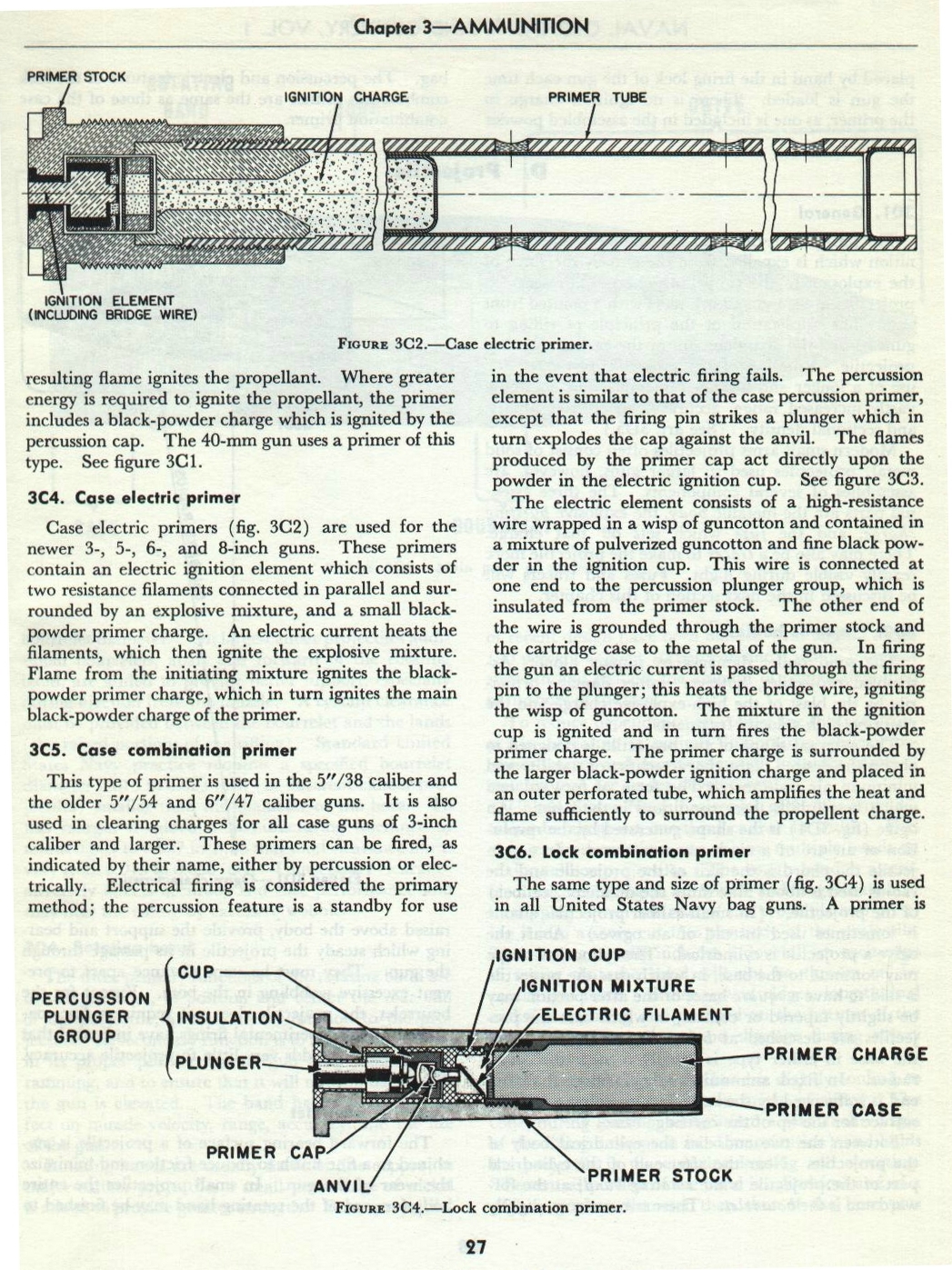
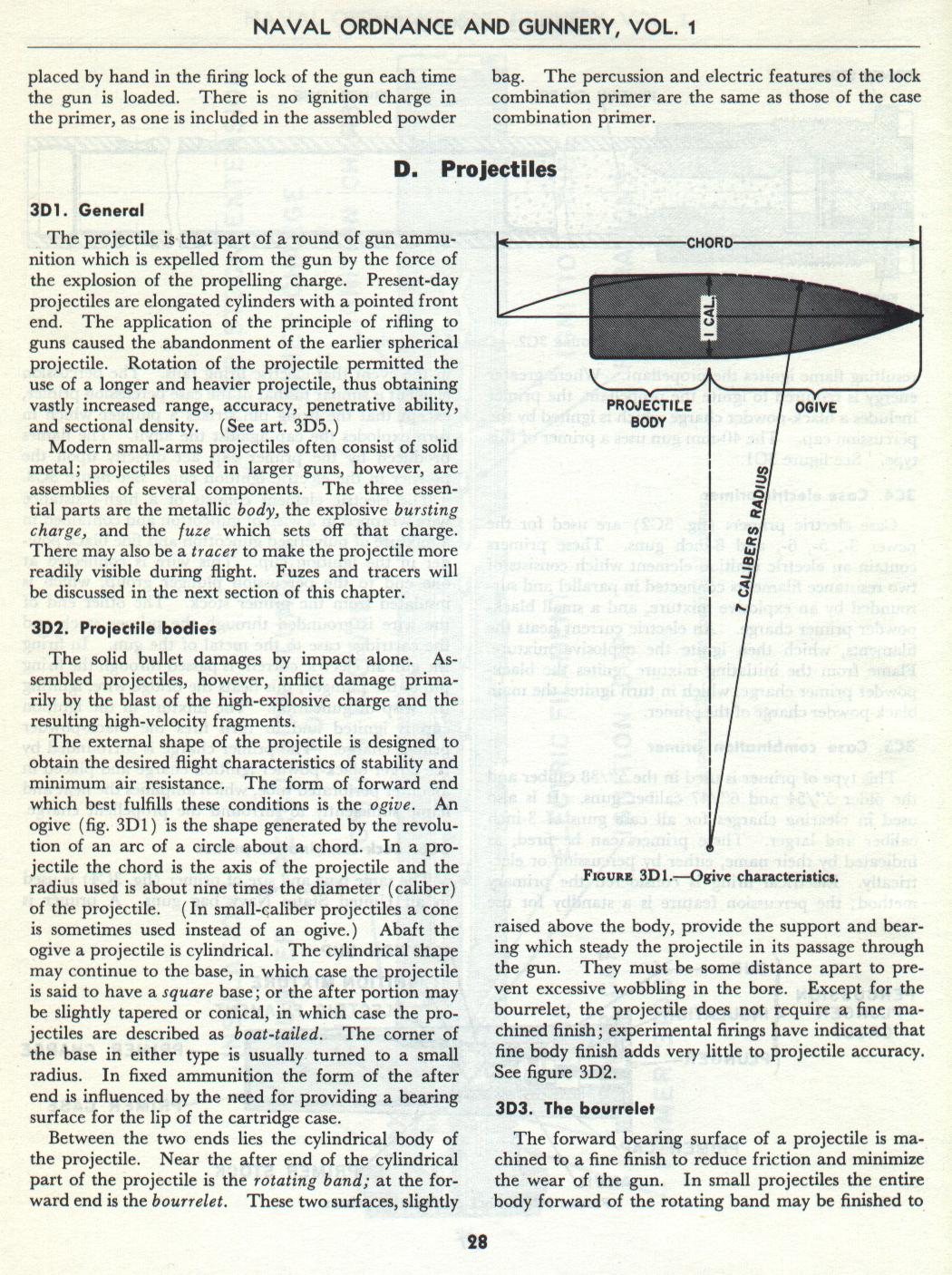
The Lock Combination Primer is so called because it can be fired both by percussion and electrically. See the two ammunition pages below (pages 27 and 28 of Naval Ordnance and Gunnery).
When the projectile is seated, it does not seat in the rifling or lands and grooves as is indicated in some parts of the text books, but rather it seats in the band front slope. The rammer stalls out to seat the projectile here, and the projectile always seats at the same spot in a new gun or a worn gun, which is important for accuracy.
Chapter 7, which is included, describes much about the 16″/50 gun; the 16″/45 gun is almost identical, so the data is good for both guns.
Much more detail is shown in OP 769 — Configuration of the Three-Gun Turrets, USS New Jersey, 30 April 1968 reactivation.
If you will look in Chapter 2, Turret Operation, you will find a much more detailed description of the turret operation and of the duties of each man.
In Chapter 19, Tools and Accessories, you will find pictures and descriptions of all of the necessary tools required.
I hope this gives you a better idea of what goes on with a bag-gun turret.
— Gene Slover
Gene’s Original Typed Pages
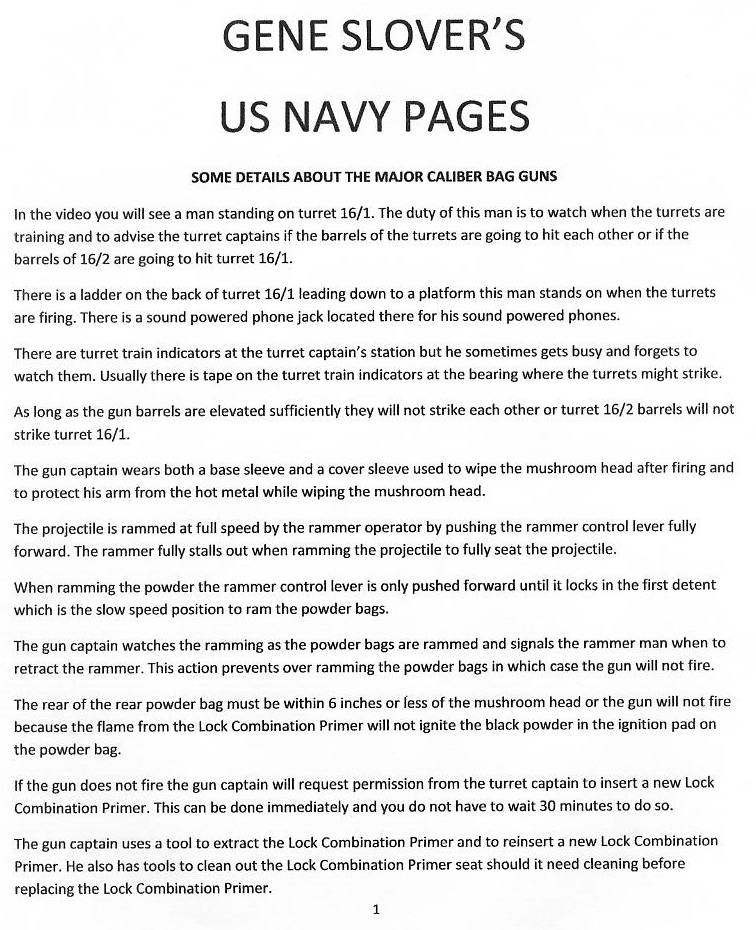
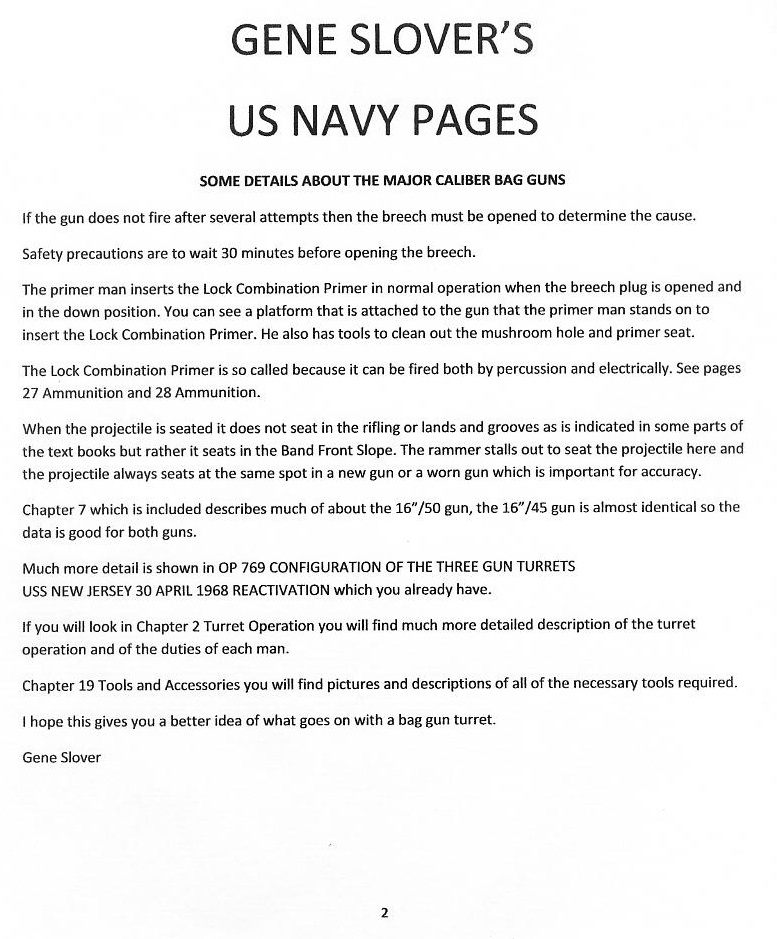
The commentary above is Gene’s own text, set here as type so it can be read on any screen and searched. His original two typed pages are below as he wrote them. Click either page to enlarge.
Pages 27 & 28 — Primers and Projectiles
The two pages below are reproduced from Naval Ordnance and Gunnery, Volume 1, Chapter 3 (Ammunition) — the primer types (including the Lock Combination Primer) and the parts of a projectile. The same material appears, with all of its figures, in the consolidated Chapter 3 — Ammunition. Click either page to enlarge.
Related pages:
- ▶ Loading the 16-Inch Guns — the loading video this commentary describes.
- Chapter 7 — Turret Installations
- NAVORD OP-769 — Turret Operation, Tools & Accessories