By Joe Holley, The Washington Post — Sunday, September 6, 2009
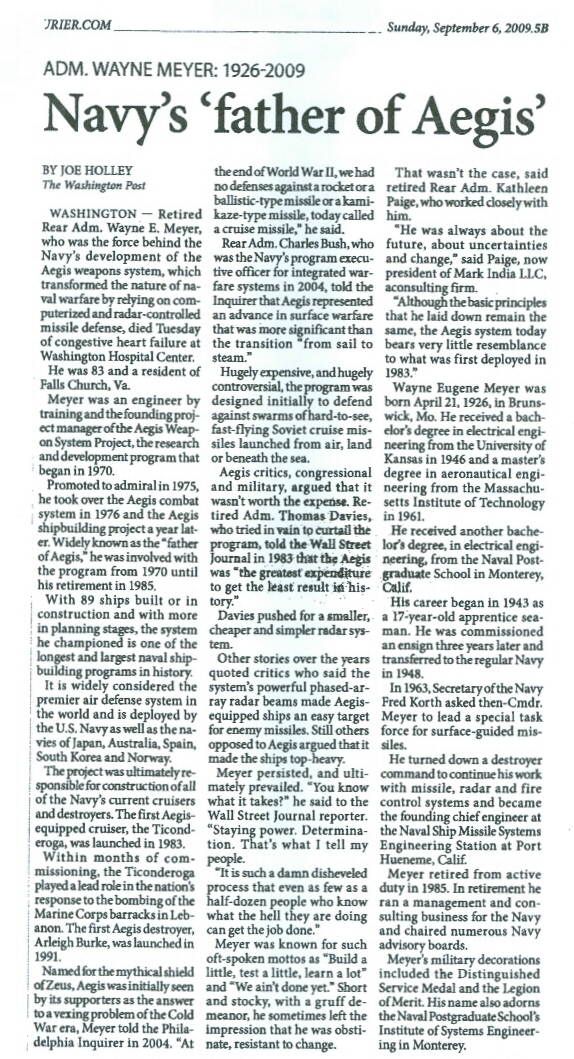
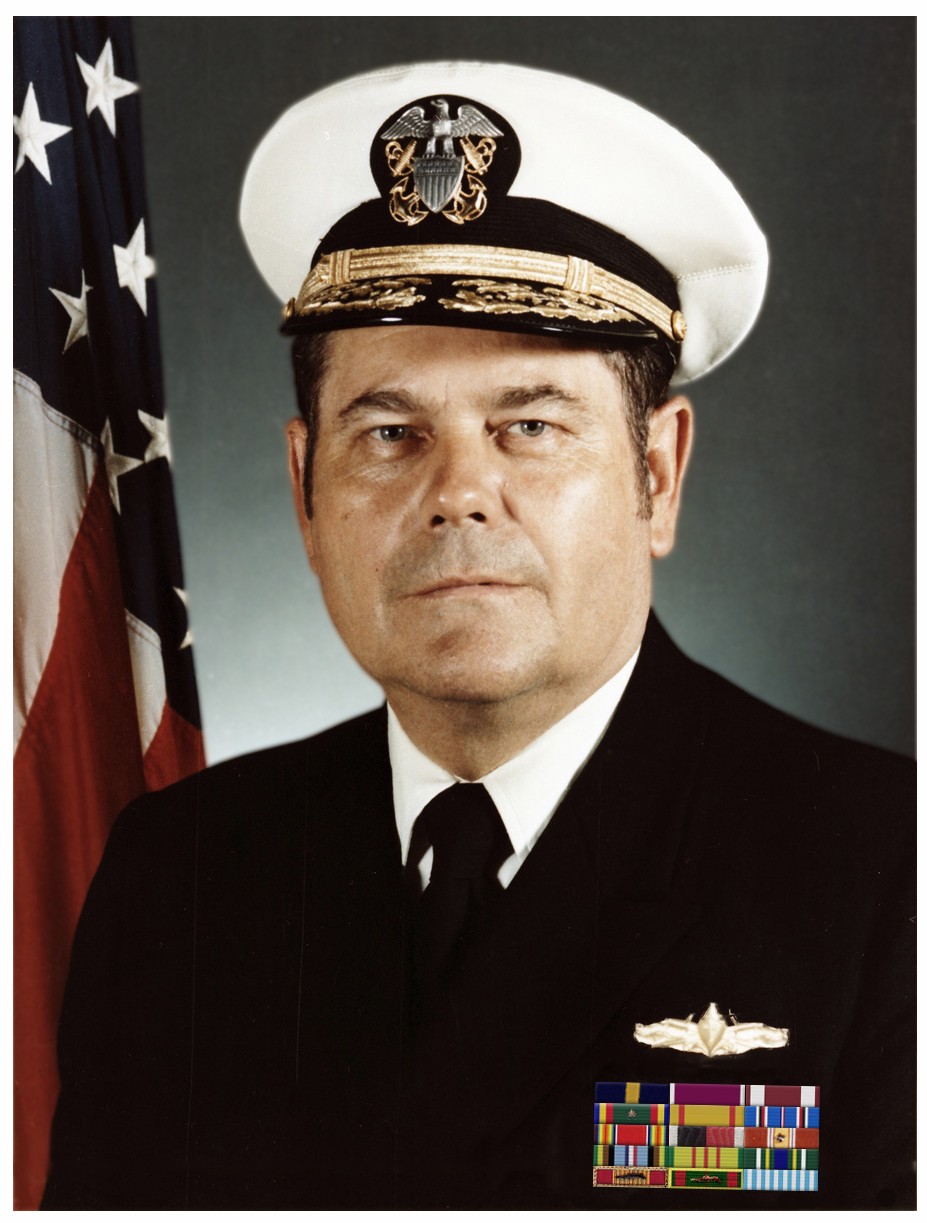
WASHINGTON — Retired Rear Adm. Wayne E. Meyer, who was the force behind the Navy’s development of the Aegis weapons system that transformed the nature of naval warfare by relying on computerized and radar-controlled missile defense, died Tuesday at a community health care center at the National Naval Medical Center in Bethesda. He was 83 and a resident of Falls Church, Va.
Meyer, who was an engineer by training, is considered a founding proponent of the Navy’s most innovative research and development programs — an officer whose acquisition model became a template for future weapons programs.
Promoted to admiral in 1973, he took over the Aegis combat system development program in 1970 and led the program until his retirement in 1985. With 89 ships built or in construction and with more in planning stages, the system he championed is one of the longest and largest ship-building programs in military history. It is widely considered the premier air defense system in the world and is used in the navies of the United States, Japan, Australia, Spain, South Korea and Norway.
The project was ultimately responsible for construction of all the Navy’s current cruisers and destroyers, including the Ticonderoga-class guided-missile cruiser. The Ticonderoga played a lead role in shooting down a disabled U.S. spy satellite. The first Aegis destroyer, Arleigh Burke, was launched in 1991.
Named for the mythical shield of Zeus, Aegis was designed initially to defend against swarms of hard-to-see, fast-flying Soviet cruise missiles launched from air, land or beneath the sea.
Aegis critics, congressional and military, argued that it wasn’t worth the expense. Members of Congress who tried in vain to curtail the program predicted sarcastically in 1983 that the Aegis was “the greatest expenditure of money in the history of the Navy.”
Other critics argued that the system’s proposed phased-array radar beams made Aegis-equipped ships easier to detect for enemy missiles. Still others contended that it simply didn’t work as advertised.
Meyer persisted, and ultimately triumphed. “Do you know what it takes?” he said to a reporter. “Staying power. I need staying power. That’s what I tell my competition. That’s what I tell my people.”

Meyer was known for such quotes: “We’ve got to test a little, test a little, learn a lot.” He was usually blunt and stocky, with a gruff demeanor; he sometimes left the impression that he was implacable, resistant to change.
That wasn’t the case, said retired Rear Adm. Kathleen Paige, who worked closely with him.
“He was always about the future, about uncertainty and change,” said Paige, now president of Mark India LLC.
“Although the basic principles he laid down remain the same, the Aegis system today bears virtually no resemblance to what was first deployed in 1963.”
He held a bachelor’s degree in electrical engineering and a master’s degree from the Naval Postgraduate School in Monterey.
His career began in 1943 as an enlisted apprentice seaman. He was commissioned an ensign three years later and transferred to destroyers to start his naval career. In 1963, Secretary of the Navy Fred Korth asked then-Cmdr. Meyer to develop a program to provide a radar air defense force for surface-guided missiles.
He turned down a destroyer command to continue his work on Aegis. He became the founding chief engineer at the Naval Ship Weapons Engineering Station at Port Hueneme.
Meyer retired from active duty in 1985. After retirement, he ran a management and consulting business for the Navy and Defense Department and served on a number of military advisory boards. His military service decorations included the Distinguished Service Medal and the Legion of Merit. His name also adorns the Naval Postgraduate School’s Wayne E. Meyer Institute of Engineering in Monterey.