
Two videos on the Navy Laser Weapon System (LaWS) — a sea trial demonstration aboard USS Ponce showing engagement of air and sea targets with targeting screen footage, and background on the LaWS program. Click a title below the player to select a video.
Navy Laser Weapon System (LaWS)
Updated May 2015
While not a visible laser, the US Navy's LaWS program has been successfully tested aboard the USS Ponce. The system will be deployed to other warships in the near future. The aptly named Laser Weapon System has passed testing and is now authorized for use as a defensive weapon.

LaWS targeting screen during engagement.
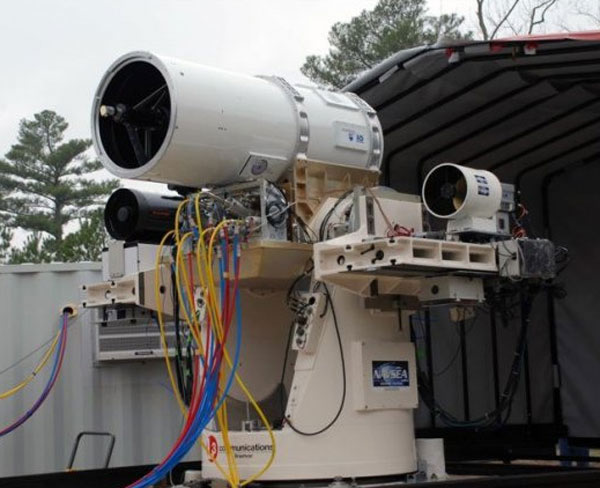
Laser unit used for testing.
For years, the U.S. Navy has been pursuing a workable directed-energy weapon that could provide a leap ahead in ship self-defense. With a series of tests of the Laser Weapon System (LaWS), it moved one step closer to that goal. Naval Sea Systems Command (NAVSEA) announced that LaWS had successfully tracked, engaged, and destroyed a drone in flight during an over-the-water engagement at San Nicholas Island, California.
Laser beams can lose strength as they travel through the moist, salty atmosphere above the sea, so the Navy requires directed-energy weapons that can work effectively in that environment. The LaWS is essentially a laser upgrade to the MK 15 Close In Weapon System (CIWS) — the Phalanx radar-guided autocannon already installed on Navy surface combatants.

Artist's concept of the laser mated to CIWS for targeting.
The tested system fired a laser through a beam director installed on a tracking mount controlled by a Mk 15 CIWS — the same system that controls the Phalanx gun. It represents a possible next step for the Phalanx, which is currently limited by the range of its 20mm autocannon. Theoretically, directed-energy weapons would increase effective range while retaining the gun as a backup.
LaWS may also have land-based applications: Phalanx guns have been used in Iraq and Afghanistan to shoot down incoming rockets and mortars, and a laser variant could avoid the problem of unexploded 20mm rounds falling back to earth.