
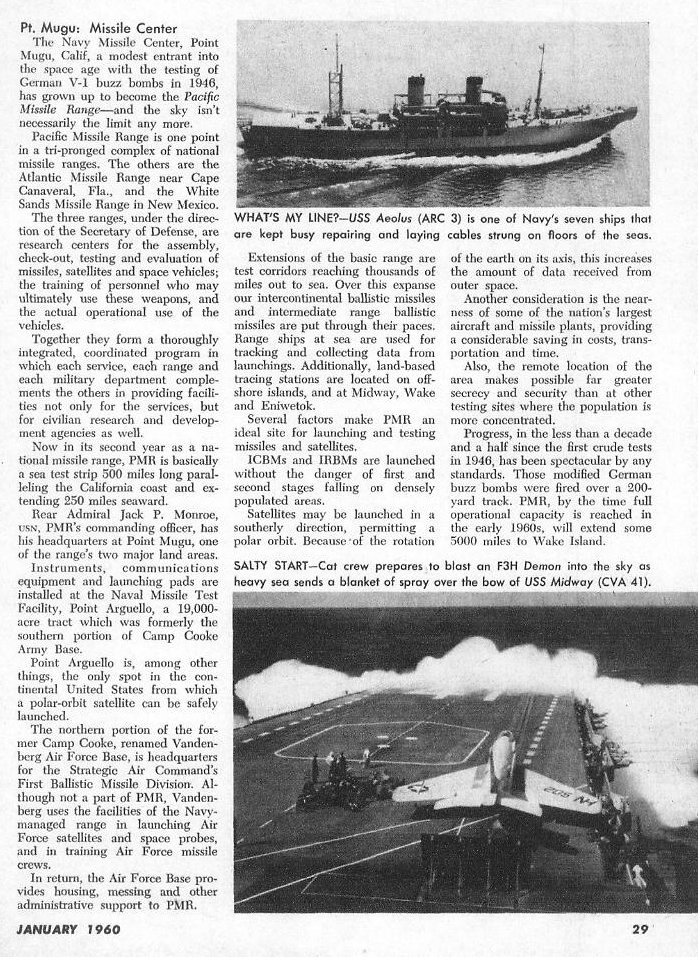
Two pages from All Hands magazine, January 1960 (pages 28–29), covering the Polaris Fleet Ballistic Missile program and operations at the Navy Missile Center at Point Mugu, California. The photograph at the bottom of page 29 shows a cat team preparing to launch an F-3H Demon as heavy seas send a blanket of spray over the bow of USS Midway (CVA 41).
Today's Navy
All Hands Magazine — January 1960
Page 28 — click to enlarge
Briefs on Polaris — Page 28
The U.S. Navy’s Polaris Fleet ballistic missile will be a solid-propelled, inertially guided missile, capable of being launched from submerged or surfaced submarines as well as surface ships. It will have an initial operational range in excess of 1,200 nautical miles and will have the capability to carry a nuclear warhead. Polaris is now in advanced stages of development. A flight test program involving two-stage solid-fuel test vehicles similar in external appearance to the final missile is underway at the Atlantic Missile Range, located at Cape Canaveral, Florida.
The Polaris missile is scheduled to be ready in 1960 for service aboard nuclear-powered submarines. The first of these, USS George Washington, SSB(N) 598, was commissioned on 30 Dec 1959. Launch dates for Patrick Henry, SSB(N) 599, and Theodore Roosevelt, SSB(N) 600, and Robert E. Lee, SSB(N) 601, were 22 September, 3 October and 18 December respectively.
Plans for Polaris (named after the North Star) were first announced in January 1957. Because of the space, weight and handling limitations of its shipboard mission, Polaris was designed to be smaller and lighter than other IRBMs. In January 1958 the Navy announced an accelerated development schedule with the 1960 target date for operational use. In September 1958, a more advanced series of test-firings began employing development test missiles close to final Polaris configuration.
All aspects of the program are proceeding in parallel and interlocking channels designed to have each component ready at the target date. These constitute the Fleet Ballistic Missile Weapon System.
Like the other ballistic missiles, Polaris will be basically a projectile traveling a ballistic path through space, lifted to altitude and set on course by its original propulsion and guidance components, and then governed by natural forces such as gravity on its way to the target. The missiles are primarily designed for submarine use but they can be fired from surface ships just as effectively.
A converted cargo ship — now Compass Island (AG 153) — was commissioned in November 1956 to develop the navigational equipment needed for accurate shipboard use of the FBM system. The result is the Navy’s Ship Inertial Navigation System (SINS), which can position the firing ship with such accuracy that its missiles can strike target areas at very long ranges. SINS determines true north, true vertical ship position and speed to supply the data necessary for pinpoint firing.
The nuclear-powered FBM submarines will be named for distinguished Americans. They include: USS George Washington, Patrick Henry, Theodore Roosevelt, Robert E. Lee, Abraham Lincoln, Ethan Allen, Sam Houston, Thomas A. Edison and John Marshall.
The launcher-test programs have been in progress for some time. Operations Skycatch and Peashooter, at San Francisco Naval Shipyard, are dryland operations to pioneer testing of methods of ejecting the missile. Operations Pop-up and Fishoak at San Clemente are tests from a submerged launcher.
Next to the standing launch pad at Cape Canaveral a ship’s motion simulator has been installed, from which a test vehicle was successfully launched on 14 Aug 1959, under conditions approximating those encountered from a ship at sea. Following the simulated sea-going launch, a Polaris test vehicle was launched on 27 Aug 1959, from USS Observation Island (AG 154), that has been especially converted for this purpose.
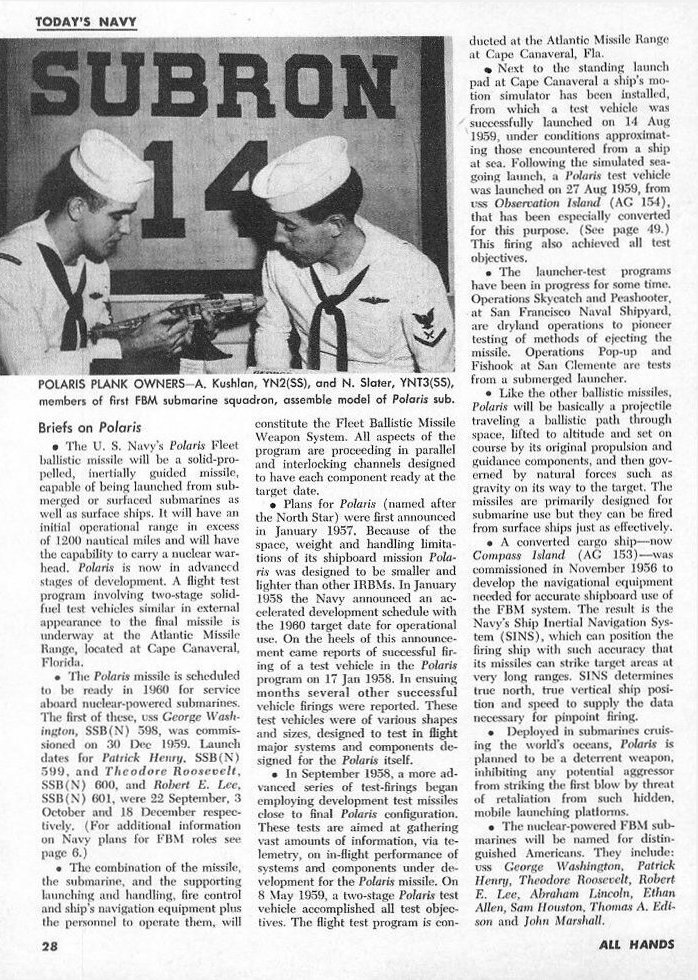
Photograph caption, page 28: POLARIS PLANK OWNERS — A. Kushlan, YN2(SS), and N. Slater, YNT3(SS), members of first FBM submarine squadron, assemble model of Polaris sub.
Page 29 — click to enlarge
Pt. Mugu: Missile Center — Page 29
The Navy Missile Center, Point Mugu, Calif., a modest entrant into the space age with the testing of German V-1 buzz bombs in 1946, has grown up to become the Pacific Missile Range — and the sky isn’t necessarily the limit any more.
Pacific Missile Range is one point in a tri-pronged complex of national missile ranges. The others are the Atlantic Missile Range near Cape Canaveral, Fla., and the White Sands Missile Range in New Mexico. The three ranges, under the direction of the Secretary of Defense, are research centers for the assembly, check-out, testing and evaluation of missiles, satellites and space vehicles; the training of personnel who may ultimately use these weapons, and the actual operational use of the vehicles.
Together they form a thoroughly integrated, coordinated program in which each service, each range and each military department complements the others in providing facilities not only for the services, but for civilian research and development agencies as well.
Now in its second year as a national missile range, PMR is basically a sea test strip 500 miles long paralleling the California coast and extending 250 miles seaward. Rear Admiral Jack P. Monroe, USN, PMR’s commanding officer, has his headquarters at Point Mugu, one of the range’s two major land areas.
Extensions of the basic range are test corridors reaching thousands of miles out to sea. Over this expanse our intercontinental ballistic missiles and intermediate range ballistic missiles are put through their paces. Range ships at sea are used for tracking and collecting data from launchings. Additionally, land-based tracing stations are located on off-shore islands, and at Midway, Wake and Eniwetok.
Several factors make PMR an ideal site for launching and testing missiles and satellites. ICBMs and IRBMs are launched without the danger of first and second stages falling on densely populated areas. Satellites may be launched in a southerly direction, permitting a polar orbit. Because of the rotation of the earth on its axis, this increases the amount of data received from outer space.
Another consideration is the nearness of some of the nation’s largest aircraft and missile plants, providing a considerable saving in costs, transportation and time. Also, the remote location of the area makes possible far greater secrecy and security than at other testing sites where the population is more concentrated.
Progress, in the less than a decade and a half since the first crude tests in 1946, has been spectacular by any standards. Those modified German buzz bombs were fired over a 200-yard track. PMR, by the time full operational capacity is reached in the early 1960s, will extend some 5,000 miles to Wake Island.
Top photograph caption, page 29: WHAT’S MY LINE? — USS Aeolus (ARC 3) is one of Navy’s seven ships that are kept busy repairing and laying cables strung on floors of the seas.
Bottom photograph caption, page 29: SALTY START — Cat crew prepares to blast an F3H Demon into the sky as heavy sea sends a blanket of spray over the bow of USS Midway (CVA 41).
“Don’t shoot me ‘till the bow comes up.” The flight deck on a Midway or Essex is about 50 feet above the water line. When the bow scoops up water so deep that when it rolls down the flight deck and is still 20 feet deep when it passes the island, you can say you have sailed in some rough waters. Been there done that.
— Gene
For more on carrier operations in heavy seas, see: