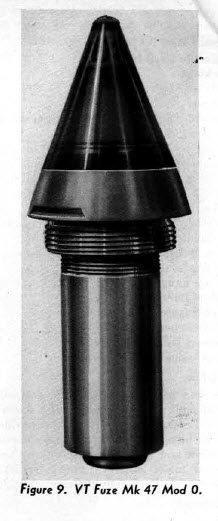
Ordnance Pamphlet 1480 (1st Rev.) describes U.S. Navy Radio Proximity (VT) fuzes for
projectiles and spin-stabilized rockets—their operation, characteristics, and usage.
The various types of proximity or influence fuzes for gun projectiles, howitzer projectiles,
mortar projectiles, rockets, bombs, and other missiles are designated by all U.S. Services
as VT fuzes. The term VT has no significance or meaning as an abbreviation, but was devised
for general usage in shipment orders, stock cards, and loading lists when security
requirements during the war necessitated it.
Two videos below cover the fuze’s development at Raytheon and live-fire testing
at Dahlgren, Virginia. Click a title below the player to select a video.
The first video provides background on the development of the VT Fuze by Raytheon—the
forces it undergoes and the principles of operation. A modified hearing aid tube was an integral
part of the design. Gen. Omar Bradley appears second from left in a 1942 photo.
The second video is silent and shows VT Fuze testing at Dahlgren, Virginia, where the fuze
was tested with live fire over a wire screen 70 feet above the water. You can see how accurately
the fuze detonates the shell over the mesh.
OP-1480 (1st Revision, 15 May 1946) covers all U.S. Navy Radio Proximity VT fuzes
approved at the time of publication. Nine chapters cover the approved types of projectile
and rocket fuzes, their construction, principles of operation, and service data. Two
appendices provide supplemental reference tables. Use the
Full Table of Contents button (lower-right) to jump to any chapter or appendix.
Using the viewer: Use the
Full Table of Contents button (bottom-right) to jump to any chapter.
Use the double caret (») at top right of the viewer to adjust scrolling.
⇓ Download OP-1480 PDF — 9.1 MB
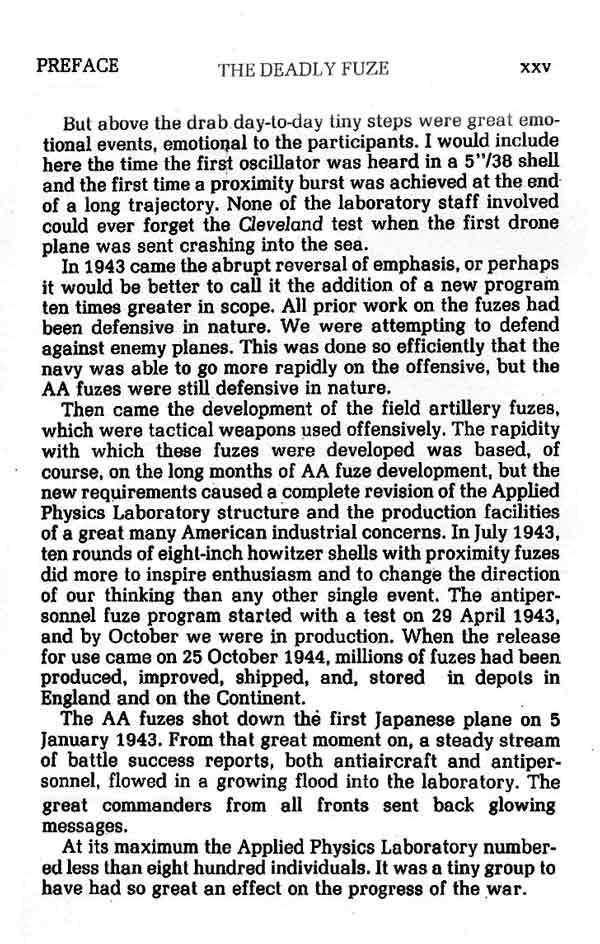
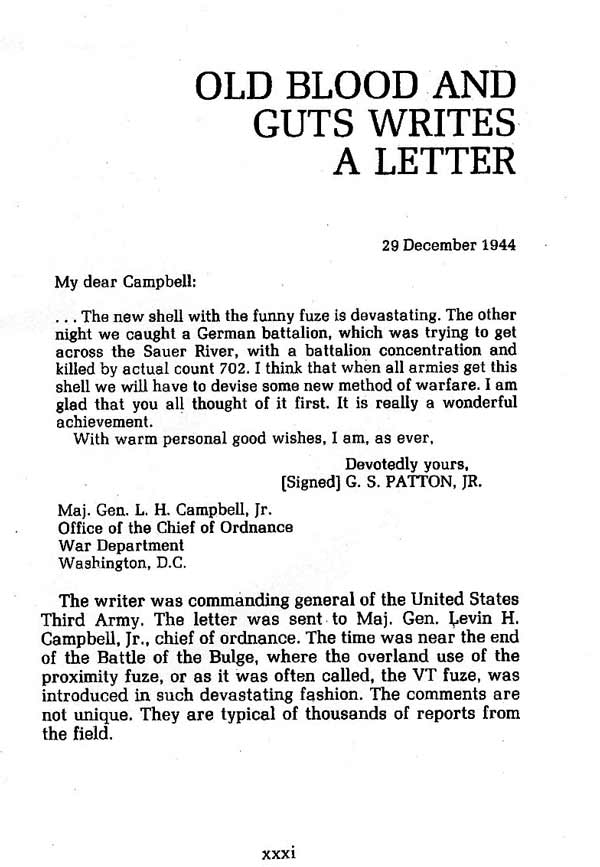
The following are excerpts from the preface of The Deadly Fuze. They show the
dedication of the people who developed the fuze and the appreciation of Gen. George S. Patton Jr.,
who recognized its importance to warfare at the time and in the future.