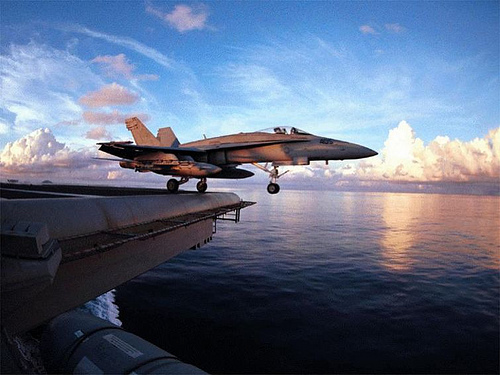
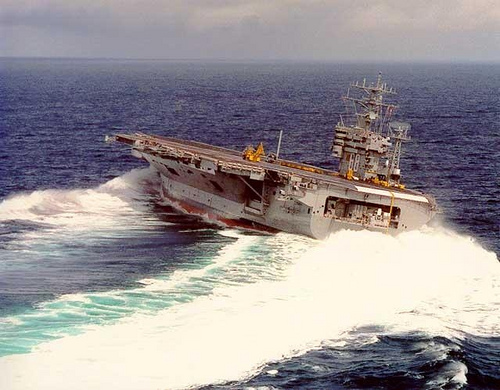
A page of Gene Slover’s perfectly timed photographs — the kind of shots that catch a naval gun at exactly the right instant. The first two are firing photos, and since the main subject here is gunnery, Gene set down a few of his own fire control considerations to go with them. The last three are simply photos Gene enjoyed. Click any photo to enlarge.
Gene’s Fire Control Considerations
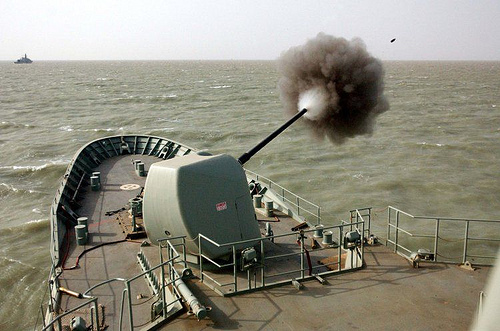
The compression in the gun is so high the gases in the barrel go to liquid. The white stuff you see coming out of the muzzle is the liquid going back to the gaseous state. The liquid is going back to the gaseous state as fast as it possibly can, and it sticks straight out from the barrel about the length of the barrel and then disappears as invisible gas.
You can see it sticking through the black smoke.
It does, however, hold together rather in a cigar shape long enough to push the projectile to a higher speed than when it left the muzzle, and does increase the projectile speed up to about 50 feet from the end of the muzzle.
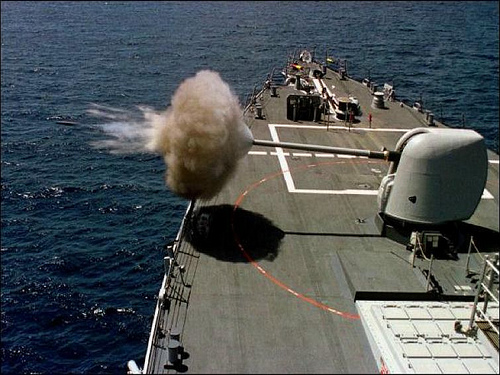
The little dab of black smoke is about the only thing that’s left unburned from the powder, and that’s all that will be left and visible.
When firing a gun, the three things that can affect the range are bore wear, projectile weight and powder temperature.
Each lot or index of powder is assigned a number, and it means that all of this powder was manufactured at the same time, and when fired in the same gun with the same weight projectile and at the same powder temperature, the projectile IV will be the same.
If you change powder index or lot, then the new powder index or lot will yield a new projectile IV.
During WWII and the Korean War we could not measure projectile weight. We did measure bore wear and powder temperature. Powder temperature was measured every hour on the hour and new computations were made accordingly.
We could not measure the rate at which roll, pitch and yaw were occurring, so we had no way to remove or back out these effects on the projectile.
The US Navy had to wait until the early 1990’s to have a gun fire control system that could do these things on the fly.
The gun fire control systems now measure rate of roll, pitch and yaw and remove them from the projectile. Each projectile has a tag of the weight of that projectile, and the weight of each projectile is fed into the computer before firing. Projectile IV from previous shots is used to compute projectile IV of the current projectile to be fired.
The system can compute for 16 targets at the same time and use the same gun to fire at the 16 different targets.
Photos Gene Enjoyed