
Every charge of U.S. Navy powder carries an index or lot number and a charge weight. These numbers are not arbitrary: they tell you which gun the charge is made for, where the powder came from, and the initial velocity (IV) it will produce in a standard gun. This page shows how to read those numbers off a real ship’s ammunition list and off the powder bag itself, and what the index lettering means.
Reading a Ship’s Ammunition List
A note on this section: The list below was furnished by Gene's good friend and Battleship Forum member, BOBC 59, for ammunition received from an ammo lighter. The reading of the BB-59 ammunition list below is Gene Slover’s own commentary — his interpretation of the entries in the ship’s war diary.
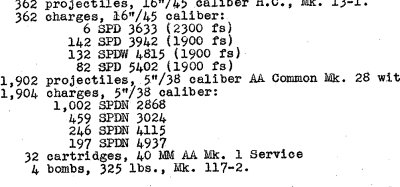
The list above is from the war diary of “Big Mamie,” the battleship USS Massachusetts (BB-59), and records the ammunition she received from an ammunition lighter:
- 362 projectiles, 16"/45 caliber H.C., Mk. 13-1
- 362 charges, 16"/45 caliber
Where it says 6 SPD 3633 (2300 fs), that is the lot number the powder came from and the velocity (in feet per second) that this lot will produce in a standard gun with a standard 2,700-pound projectile.
The next three lots of powder tell you that these three lots will produce 1,900 fs when fired in a standard gun, but they did not say which projectile the powder charge is for. Because the powder charge is for 1,900 fs — reduced velocity — the charge is probably for firing back slopes, and the projectile to be used is probably H.C.
BB-59 received four different lots of powder for the 16"/45 guns and four different lots of powder for the 5"/38 guns. A ship always receives several different lots of powder so that, if something is wrong with one lot, the ship can still fire.
The list does not give the weight of a full charge for each lot of powder, but that weight would have been printed on each powder can, along with all of the data above.
Markings on the Powder Bag
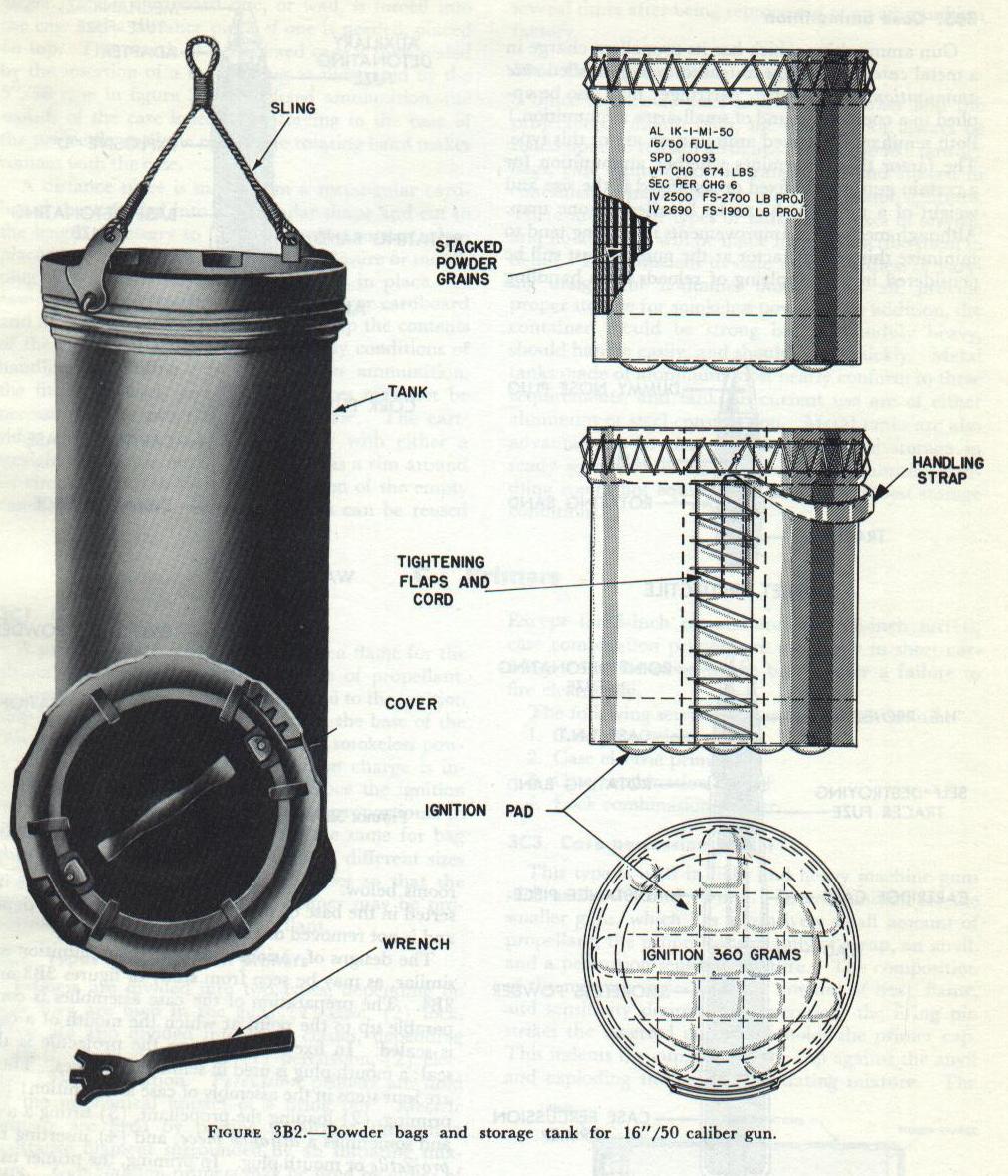
The data printed on a powder bag tells you:
- Which gun the powder charge is for
- The lot or index number the powder came from
- How many bags are required for a full charge
- How much the full charge weighs
- What the IV will be in a standard gun with a standard projectile
Because every lot of powder is weighed so that a full charge produces the gun’s design velocity, each lot has a different full-charge weight — but no matter which lot it comes from, the charge will produce the IV printed on the bag. For the full account of why this is so, see USN Powder. For the construction of the bag itself and the powder tank it is stored in, see Naval Ordnance & Gunnery, Chapter 3 — Ammunition.
Powder Index and Lot-Number Lettering
The powder boxes are stenciled with the powder designation, the place of manufacture, and the serial number of the lot. For example, IHHA Lot 40 means powder manufactured at Indian Head (IH) for the 14"/50 (HA) caliber gun, and that it is lot 40 of this particular caliber. Various letters — such as D for DuPont, I for International, and so on — designate the different manufacturers. The last one or two letters indicate the caliber and are published in a table in the powder specifications: for example, H stands for 14"/45, H.A. for 14"/50; C stands for 6"/40, C.B. for 6"/50, C.C. for 6"/53.
Proof and disposition. — A firing sample for proof at Dahlgren is selected from the lot of powder, and the balance is stored in a magazine until ordered shipped by the Bureau of Ordnance. On acceptance, the Bureau gives the lot of powder a service index number, assigned in regular numerical sequence in the order of acceptance. These indexes are also designated by certain letters — for example, SPDW 2132. The SP indicates smokeless powder, the D stands for diphenylamine (showing it is a stabilized powder), the W stands for reworked, and the number is the index number. Other letters used are R for rosaniline (used in 1908–09 as a colored indicator of the stability of the powder, but since abandoned), B for a blend of two or more indexes, X for water-dried (instead of the usual air drying), and F for flashless powder.
Manufacture of reworked smokeless powder. — Unstable powder from the service, odds and ends of powder from magazines, powder accidentally wet — in fact, any unserviceable powder — is sent to Indian Head for reworking. On receipt it is dumped into concrete vats and kept under water.
Related powder and gun IV pages:
- USN Powder — how powder is mixed to a uniform lot, tested and lot-numbered at Dahlgren, and weighed so a full charge produces the design IV.
- The USN Provided Information to the Officers and Men — Gene Slover’s commentary on why powder from the same lot does not vary gun IV.
- The Effect of Variation of Gun IV Due to Powder — the Dahlgren table showing how wild the range pattern would become if powder IV varied within a lot, and why it does not.
- Naval Ordnance & Gunnery, Chapter 3 — Ammunition — the textbook on powder bags, powder tanks, and primers.