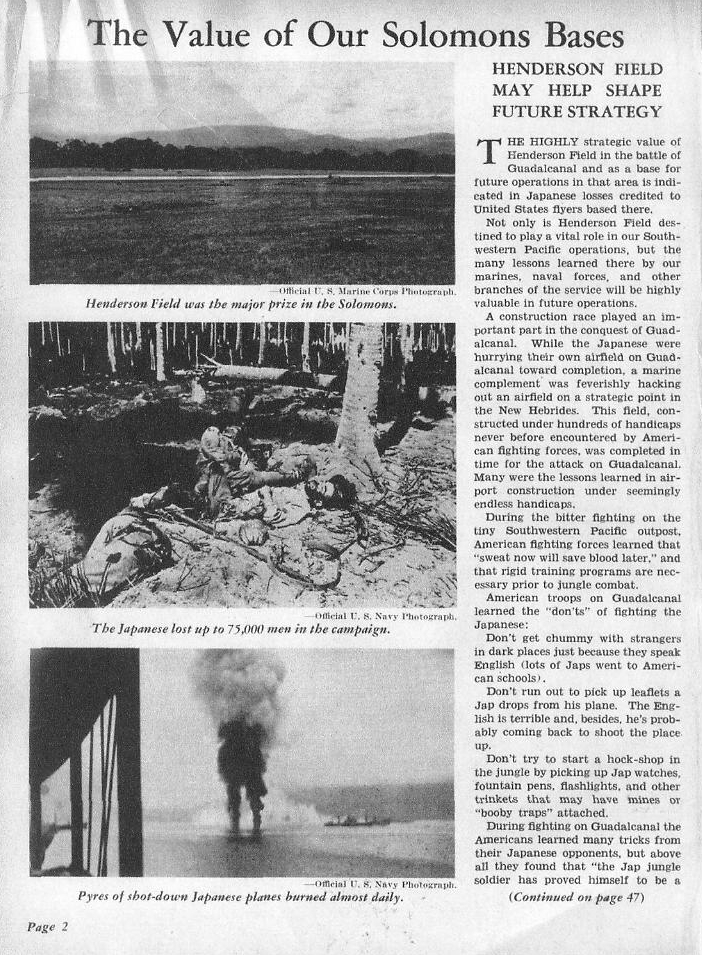
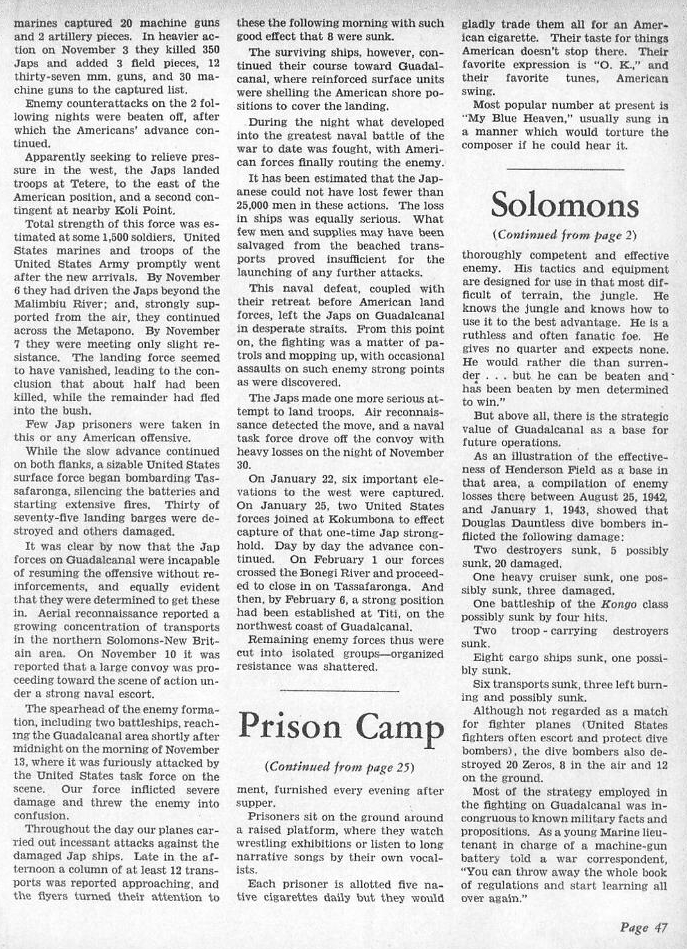
The six-month campaign for Guadalcanal ended on 9 February 1943 when the last Japanese forces were evacuated from Cape Esperance. The American victory secured not just an island but an entire strategic position: the chain of airfields and anchorages the US had seized and built across the lower Solomon Islands placed Allied land-based air power within range of the central Solomons and began the systematic compression of the Japanese defensive perimeter anchored at Rabaul. This March 1943 analysis — written within weeks of the Guadalcanal campaign’s conclusion — examines why these bases mattered and what they made possible.
The Solomons bases served three interlocking purposes. First, they denied the Japanese the airfields and anchorages from which Imperial forces had threatened Australia and interdicted Allied supply lines across the South Pacific. Second, they provided forward staging areas for the “island-hopping” advance up the Solomons chain toward Bougainville and ultimately Rabaul — a campaign that would neutralize the largest Japanese base in the South Pacific without a costly direct assault. Third, the airfields at Henderson Field, Munda, and Segi Point extended the reach of land-based fighter cover and strike aircraft, giving the Navy’s surface forces and supply convoys a protective umbrella they had lacked during the desperate early months of the Guadalcanal campaign. The two pages reproduced here — pages 2 and 47 of the source publication — address these strategic calculations in the immediate aftermath of the American victory.
Pages 2 and 47 of the source publication are reproduced here; intervening pages are not available.