Keeping Admiral William F. Halsey’s Third Fleet fueled, armed, and provisioned while it operated continuously across thousands of miles of open Pacific was one of the great logistical achievements of World War II. The fast carrier task forces that struck the Philippine Sea, Leyte Gulf, Formosa, and the Japanese home islands consumed fuel oil at a staggering rate — a single Essex-class carrier burned roughly 8,000 barrels of fuel per day at high speed, and an entire task group of carriers, battleships, cruisers, and destroyers could consume several hundred thousand barrels on a single extended operation. No fixed base could have sustained this tempo of operations; the solution was underway replenishment at sea.
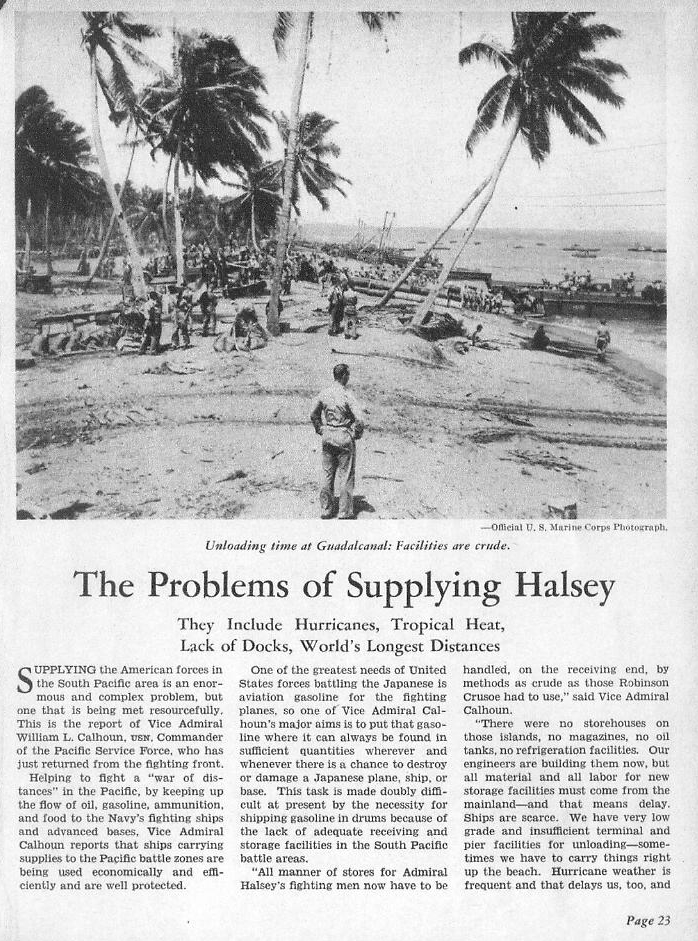
The US Navy’s Service Force, Pacific Fleet — informally “ServRon 10” — built and operated the fleet train that made sustained offensive operations possible. Oilers, ammunition ships, stores ships, and escort carriers carrying replacement aircraft rendezvoused with the combat forces at designated replenishment areas, transferring thousands of tons of fuel, ordnance, food, and aircraft while both ships steamed in formation. The destroyer screen presented a particular challenge: destroyers had limited fuel capacity relative to their consumption at high speed, and their fuel state frequently constrained the entire task force’s freedom of movement. Typhoon Cobra in December 1944 demonstrated the lethal consequences when three destroyers running dangerously low on fuel capsized in heavy seas. The two pages reproduced here examine the specific supply problems faced by Halsey’s command during the final year of the Pacific War.
These are pages 23–24 of the source publication; preceding and following pages are not reproduced.