Home›Videos›GBAD Ground Based Anti-Drone Lasers on Trucks
US Navy GBAD
Ground Based Air Defense — Anti-Drone Lasers on Trucks
▶
Originally published in Popular Science, 18 April 2015, by Kelsey D. Atherton.
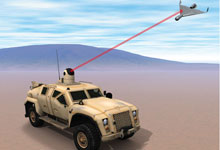
The Navy is building a system of trucks that will fight drones with lasers. The “Ground-Based Air Defense Directed Energy On-the-Move” weapons program — GBAD — puts a 30-kilowatt laser on the back of a Humvee (or other light vehicle) and sensors on two additional Humvees. When Marines drive onto the battlefield, they can shoot down any cheap, hostile drones that try to attack them.
GBAD’s evolution has mirrored other directed-energy programs sponsored by the Office of Naval Research (ONR), including the Laser Weapon System (LaWS). It is a cost-effective defense against asymmetric threats like UAVs. While expensive to build, lasers are in theory much cheaper to use than other anti-air weapons — especially anti-air missiles, and cost-competitive with heavy machine gun anti-air turrets.
Click to Play
US Navy GBAD Ground Based Air Defense — Office of Naval Research (5 minutes)
Already, a ship-board directed energy weapon has burned holes into target drones. Modern warships carry tremendous on-board power — the Navy’s Zumwalt Destroyer is expected to have 58 megawatts available for such weapons. Ground systems are trickier: the laser on the USS Ponce is 30 kilowatts, while the Navy plans ship-borne lasers as powerful as 100–150 kilowatts. In December 2013, the US Army’s HEL-MD laser system used a truck much larger than a Humvee and carried only a 10-kilowatt weapon.
According to ONR, the Humvee-mounted system uses the same 30-kilowatt laser as the Ponce. Two support vehicles accompany it: one with 360-degree radar to detect targets, and one with a laser command center — ensuring a human remains in charge even as the autonomous targeting software selects targets.
The Navy planned a “completely stationary end-to-end engagement” for late 2015, followed by a mobile cueing and tracking demonstration in FY2016, with the goal of showing the system can fight drones, move, and engage again by 2017. If successful, future Marines will be able to quickly blind the robot eyes of whoever wishes them harm.
Get a free email whenever a new page like this goes up — original gun books,
ordnance pamphlets, and wartime film straight from the archive. No spam, unsubscribe any time.