Thanks to Senior Chief Sid Busch for finding this story.
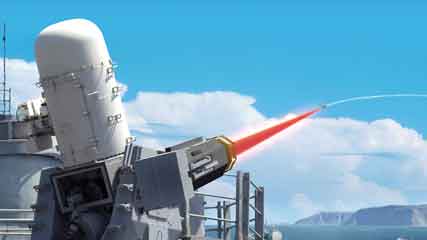
Raytheon laser weapon illustration. If it looks like the Phalanx CIWS, that’s because it uses the same tracking system.
Fiber-optic lasers are emerging as promising candidates for future weapons-grade solid-state laser systems on jet fighters, land vehicles, and possibly even man-portable systems. The following video is a test firing carried out in May 2010 — the weapon successfully downed four drones over the Pacific Ocean off San Nicolas Island, the naval weapons proving ground off the coast of California.
Ed. note: You’d think any company capable of shooting down a drone with a light beam would have a video that didn’t look like Flash Gordon.
Click to Play
Raytheon Fiber Laser Drone Kill Test — May 2010 (41 seconds)
The solid-state fiber laser is capable of taking out mortar rounds, rockets, UAVs, and small surface ships by emitting a destructive 50-kilowatt beam of light. Unlike the first chemical reaction lasers produced decades ago, Raytheon’s solid-state laser consists of six industrial-strength beams produced by channeling extreme amounts of energy through glass or ceramic materials.
On July 19, 2010, Raytheon official Mike Booen explained: “One of the Navy’s problems is that the bad guys have unmanned aircraft now — they can give away ships’ positions. So we wanted to do a more real-world test of the laser over water.”
The test involved tracking drones with sensors from a Raytheon-built ship defense system, then destroying them with a high-powered fiber laser. Taylor W. Lawrence, president of Raytheon Missile Systems, stated the team “demonstrated the systems’ capability to detect, track, engage and defeat dynamic targets at tactically significant ranges in a maritime environment.”
Scientists have long struggled with creating a device that can produce enough power to be useful while being compact enough to deploy. Fiber lasers have been gaining traction as a weapon candidate because of their efficiency — more easily cooled, small and lightweight, and relatively straightforward to scale up in power. They have the potential to edge out other solid-state approaches such as slab lasers and free-electron lasers.
More About Fiber Lasers
Up to now, weapons-grade lasers have primarily been large, complicated devices operating on large platforms such as jumbo jets, surface ships, and large tractor-trailers. Solid-state lasers, however, have the potential in the near term to operate on relatively small platforms such as jet fighters, where they could destroy land vehicles, missiles, or other aircraft.
Get a free email whenever a new page like this goes up — original gun books,
ordnance pamphlets, and wartime film straight from the archive. No spam, unsubscribe any time.