
Material on this page was generously furnished by Bob Carbone (BOBC-59), who served aboard USS Massachusetts and is a plank owner. Bob has been a frequent and welcome contributor to the Battleship vs. Battleship Forum.
Combat Damage Photo
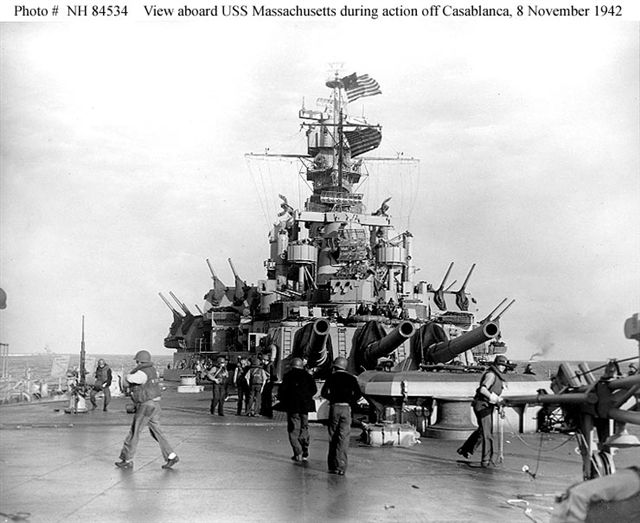
Bob Carbone, November 2009: “Note the shell holes on the ensigns — look how close they came to do damage to radar etc. I just saw this, did not realize how close they came.”
Photo courtesy Bob Carbone (BOBC-59). “For those that fought for it, Freedom has a taste and meaning the protected will never know.”
War Diary & Deck Logs 1942–1945
The following PDF files detail the daily activities aboard USS Massachusetts from October 25, 1942 through December 31, 1945. Information includes ship movement, drills, battle action, enemy activity, refueling, restocking of food, supplies and ammunition, visits by various Admirals, and strategies.
The files have been optimized for search — you can find a particular date or event easily by searching within the PDF for terms such as “enemy” or “general quarters.”
| Period | File Size |
|---|---|
| 13 November 1942 — Battle of Casablanca | 3 MB |
| 4 December 1942 through 4 July 1943 | 7.1 MB |
| 5 July 1943 through 25 November 1943 | 7.6 MB |
| 26 November 1943 through 12 September 1944 | 5.8 MB |
| 13 September 1944 through 11 November 1944 | 4.9 MB |
| 12 November 1944 through 31 December 1945 | 5.7 MB |
Life Aboard — Water Tender Rate, In Bob’s Own Words
When I was oil/water king my main duties were keeping the ship on an even keel and keeping the fire rooms’ service tanks ready. I also tested the boiler water for the right salinity and pH, kept the fresh water for everyday use at the proper salinity, transferred fuel oil from storage to boiler room service tanks, and moved ballast for trimming. I also ran tests like flash point and viscosity on newly received fuel oil.
After I made 2nd class I went into the fire room for duty on the lower level as feed pump and service pump operator, or on the upper level as check valve operator. That is a rough one — keeping the boiler water at a constant halfway mark. It will vary a bit on a zigzag, or really vary on a speed change up or down.
When I made 1st class I was Petty Officer in charge of the shift if no chief was around. When in port, whether we had hotel duty or not, we did our own maintenance — cleaning fire side and/or water side, repairing the firebox, and replacing leaking water tubes in boilers and condensers. We did everything that needed to be done to be battle ready at all times. Fire room #3 was my battle station — water check #5 and #6 boilers.
That’s what a water tender rate’s duties were in a nutshell: anything to do with the operation of the fire room and water, fuel oil, and ballast. When I got out my rank was WT1c. I probably left out some duties but, hell, it was 60-odd years ago. — Bob Carbone