
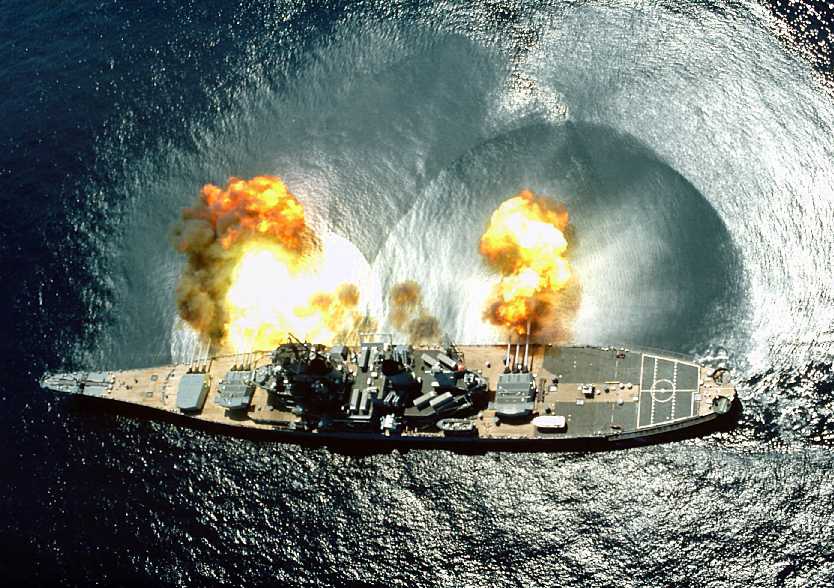
A 15-gun broadside consists of 9 sixteen-inch guns and 6 five-inch guns firing simultaneously.
The center of the muzzle blast is about 85 feet from the side of the ship. The visible part of the muzzle blast sphere is about 500 feet in diameter and reaches a maximum width of about 600 feet when in full bloom. A single gun firing causes a depression in the ocean about 17 or 18 feet deep and about 600 feet wide. The sphere is much larger in diameter than that, but you only see a small portion of the bottom of the sphere in the ocean. This depression from a single gun displaces about 11,000 tons of water.
When a 3-gun salvo is fired, the depression in the ocean is over 25 feet deep and the visible diameter of the sphere in the ocean is about 1,000 feet. A full broadside from the ship displaces about 100,000 tons of water — almost twice the weight of the ship itself. The displaced water pushes against the side of the ship and moves it sideways.
How much the ship is pushed sideways depends on its speed. During shore bombardment at about 5 knots, the ship moves uniformly sideways from bow to stern about 9 feet. At faster speeds the bow is held more firmly by the bow wake, and the reduced water pressure along the ship's sides allows the rudders to more easily turn the ship by pushing the fantail sideways through the water.
The faster the ship is going, the lower the water pressure against the hull and the faster the ship will turn. The same principle applies to the muzzle blast — the fantail is pushed away from the direction of gun fire and the ship turns toward the line of fire.
In the photograph above, the ship is traveling at about 10 or 12 knots and is in a starboard turn of about 3 or 4 degrees toward the line of fire. Looking at the ship's wake, the bow wake to starboard is some distance from the ship while the bow wake to port is tight against the hull.
I used to love to watch this. When I could get away from my fire control duties I would go to the pilothouse and take the wheel — there you can watch the compass and see the ship turn when the guns are fired. I was always impressed by this then and I'm still impressed today. Battleships, cruisers, and destroyers all move sideways the same relative amount, because the ships are proportional in weight, length, beam, and size of armament.
The ship is 888 feet long and 108 feet wide.
Turret Emplacement Data
| Turret | Distance from Bow | Trunnion Height (above waterline) |
|---|---|---|
| 16/1 | 224 feet | 26.15 feet |
| 16/2 | 296 feet | 34.65 feet |
| 16/3 | 642 feet | 28.40 feet |
Gun trunnions are 132 inches forward of the turret center line.
The muzzle is 535.4 inches forward of the trunnion center line.