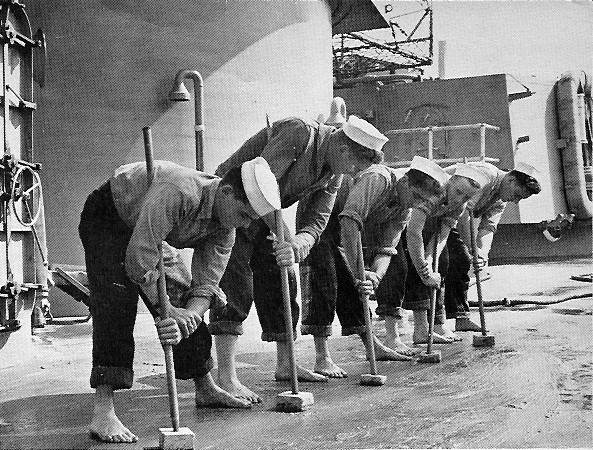
Holystoning is the practice of scrubbing a ship’s wooden deck with a block of soft sandstone, using sea water and sand as the cutting agent. The stone shaves a thin layer off the planking, taking stains and weathering with it and leaving the wood a clean, pale, ashen white. It was a daily or near-daily chore aboard sailing warships and merchantmen, and it survived in the US Navy on teak-decked ships well into the twentieth century. The stone itself is also called a holystone, and in the US Navy the word is written as one word.
Gene’s Account — USS Missouri BB-63
“Holy Stone is actually soft sandstone, a sedimentary rock formed by the consolidation and compaction of sand and held together by a natural cement, such as silica. Holystone is all one word in the USN and you really don’t want to be the one doing it. When you Holystone Teak you use liberal amounts of sea water. (It’s only done in peace time. During WWII the decks were painted deck gray, which is really a dark blue, to camouflage the ship from air attacks.) After holystoning the teak becomes sort of ashen white and it’s really pretty. Our shoes had black rubber heels and you could put a black mark on the teak. If you did, you damn well better not let a boatswain see you or you would be doing hours of holystoning.”
— Gene Slover
The video below shows the process on Missouri’s teak.
Holystoning the teak deck of USS Missouri BB-63 — 2 min. 22 sec.
What a Holystone Was
A holystone is a block of soft, brittle sandstone — sedimentary rock formed from compacted sand held together by a natural cement such as silica. Softness is the point: the stone has to wear away against the deck rather than the other way round, so that it abrades the top surface of the plank evenly instead of gouging it.
Sailors gave the stones names by size. The small hand-sized stones used for tight spots were called prayer books; that name is confirmed firsthand by Richard Henry Dana Jr., who sailed before the mast in 1834–36. Larger stones are widely reported to have been called Bibles. Dana records only the term “prayer-books,” so the “Bible” usage rests on later sources rather than on his eyewitness account.
| Material | Soft, brittle sandstone |
| Used with | Sea water and loose sand |
| Small hand stone | “Prayer book” |
| Large stone | “Bible” (reported; not in Dana) |
| Purpose | Clean, whiten and dress down wooden decking |
| Typical time | Early morning, before breakfast |
| US Navy status | Restricted to stain removal, 1930s |
How It Was Done
Dana’s Two Years Before the Mast (1840) gives the clearest eyewitness description of the work. The decks were first washed, scrubbed and scraped, then wetted and sanded all over, and only then holystoned:
“The holystone is a large, soft stone, smooth on the bottom, with long ropes attached to each end, by which the crew keep it sliding fore and aft, over the wet, sanded decks. Smaller hand-stones, which the sailors call ‘prayer-books,’ are used to scrub in among the crevices and narrow places, where the large holystone will not go.”
— Richard Henry Dana Jr., Two Years Before the Mast, 1840
The large stone, in other words, was not carried but dragged — a team hauling it back and forth along the planking by ropes at each end. Small stones were worked by hand, on the knees, in the seams and corners. Dana says the crew were kept at it “an hour or two,” after which the head-pump was manned and all the sand washed off the decks and sides, followed by swabs and squilgees to dry the deck. The whole evolution had to be finished before breakfast.
It was hated work, and the sailors said so. Dana records the lower-deck verse he calls the “Philadelphia Catechism”:
“Six days shalt thou labor and do all thou art able,
And on the seventh—holystone the decks and scrape the cable.”
Where the Name Came From
The origin of the word is genuinely uncertain, and the honest answer is that no one knows. Two explanations are commonly offered, and this site is not in a position to settle between them:
- That the stones were broken up from church masonry — monuments at St Nicholas Church in Great Yarmouth, or the ruined church of St Helens near the Isle of Wight anchorage where ships provisioned — and so were literally “holy” stone.
- That the name comes from the posture: holystoning the deck was done on one’s knees, as in prayer. This is the explanation the US Navy itself has generally offered, and it fits the “prayer book” and “Bible” nicknames.
Both are plausible and both are unproven. The nicknames for the stones are at least consistent with the second.
The Navy Restricts Holystoning
Holystoning cost the Navy decks. Every scrub removed wood, and by the late 1920s the new 10,000-ton treaty cruisers were being built with deliberately thin decking to save weight for armament — so the practice was eating up an expensive item far faster than the budget could replace it. In 1931 the Secretary of the Navy, Charles Francis Adams, announced that holystoning would be curtailed, giving exactly that reason; TIME reported the decision on 8 June 1931 under the headline “No More Holystone.”
The order as preserved in the Navy’s own compilation of General Orders 1921–1935 is General Order No. 38, dated 13 May 1935 and signed by Secretary of the Navy Claude A. Swanson. Its text reads:
“1. The use of holystones for cleaning the wooden decks of naval vessels wears down the decks so rapidly that their repair or replacement has become an item of expense to the Navy Department which cannot be met under limited appropriations.
2. The wooden decks of the new 10,000-ton light cruisers are so light that they may be made unserviceable very rapidly by the use of holystones.
3. It is therefore directed that the use of holystones or similar material for cleaning wooden decks be restricted to the removal of stains.
4. Wooden decks will usually be cleaned with brushes and sand or by such other means as will not cause excessive wear.”
— US Navy General Order No. 38, 13 May 1935
Note what the order actually says. It is frequently described as a ban, but it is not one: paragraph 3 restricts holystoning to the removal of stains, and paragraph 4 directs brushes and sand as the routine method instead. Holystoning was cut back from a daily ritual to an occasional remedy — which is why sailors were still holystoning teak decks long afterwards, as Gene’s account above describes.
A note on sourcing: many secondary accounts online date the order to 1931 and number it “General Order 215.” No such holystone order appears under that number in the Navy’s General Orders 1921–1935 compilation, where the holystone order is No. 38 of 13 May 1935. The 1931 date does correspond to Secretary Adams’s announcement reported by TIME. Rather than pick a winner, this page gives both: a 1931 announcement, and a 1935 order text that survives in the official compilation.
Why Teak
The teak decking used on the US battleships is 2” thick — an old dimension from when a 2×4 was actually a 2”×4” measurement. In the USN the teak is bolted to the steel decking, with the nut and washer recessed into the teak and a teak plug covering them. The natural oils in the teak make it weather resistant and an excellent insulator against heat. Footing is good on teak, which is why it is used extensively on sailboats as well.
Teak retains a very pleasant aroma for a long time, making it a prime wood on cruise ships as well as warships. Even though teak has natural oils, a ship at sea soaks up salt water which swells the teak and keeps it tight-fitting. Left in the sun with little water, the teak will shrink and become loose.
The USN applied teak directly to steel decks — the oils in the teak prevent the steel from rusting. In areas such as the bridge, teak is usually lacquered, installed in sections with about a one-inch spacing and a foot of clearance below for seawater runoff. The sections can be lifted for cleaning underneath. The quartermasters keep this teak polished and waxed.
Another use of teak in older battleships was as backing for side armor. In the diagrams of the IJN Kirishima, the side armor was backed by 50mm (2 inches) of teak. Since Kirishima was built to a British design, teak armor backing was likely used on other ships of the same period. Beyond its hard-wearing properties, teak has an important advantage in warships: its oil has antibiotic properties, so teak splinters do not tend to become infected. — Gene
Sources
Gene Slover’s account of holystoning Missouri’s teak, and the notes on teak decking and armor backing above, are this site’s own material. The following came from off-site sources:
- The description of the procedure, the “prayer-books,” and the “Philadelphia Catechism” verse are quoted from Richard Henry Dana Jr., Two Years Before the Mast (1840), read from the Project Gutenberg text.
- The text of General Order No. 38 of 13 May 1935 is quoted from the Naval History and Heritage Command’s online compilation of General Orders 1921–1935.
- The 1931 announcement by Secretary Adams, and the reasoning about thin treaty-cruiser decks, are from TIME, “Army & Navy: No More Holystone,” 8 June 1931.
- The competing explanations for the origin of the name are as generally reported in reference works; neither is established fact.