Coastal and Riverine Craft Armament
Throughout our history coastal and riverine craft have played a very important part in achieving victories, on sea and shore. This has been true from the American Revolution to the Vietnam conflict. Coastal and riverine craft, many of which were converted from World War II landing craft, have been used extensively in the Vietnam conflict. Their armament, which varies from craft to craft, ranges from .30 caliber machine guns to 105 mm howitzers. This chapter will acquaint you with some of these and their armament, including its operation. Keep in mind that most of these craft are of a temporary nature — activated and built only for use in the Vietnam conflict — and may or may not be in service once the Vietnam conflict is over. However, future involvement in a similar type of warfare may again require their use.
Coastal Craft and Their Armament
Coastal craft include patrol gunboats (PGs), hydrofoil gunboats (PGHs), fast patrol boats (PTFs), and fast patrol craft (PCFs). (Some coastal craft, such as the PTF and the PCF, also may be used for riverine service.) A representative number of these craft and their armament will be briefly discussed in this section. Again, keep in mind that the armament on one boat may be different from that on another boat of the same type.
Patrol Gunboat Armament
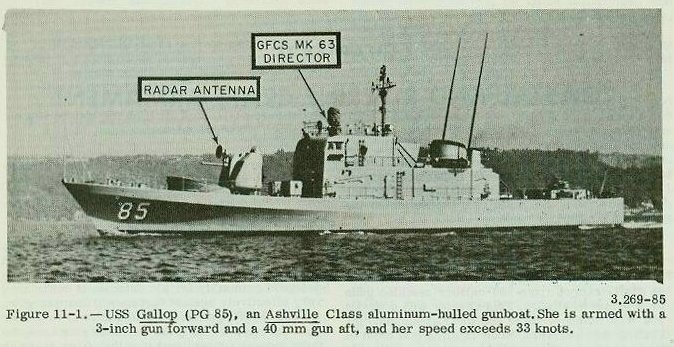
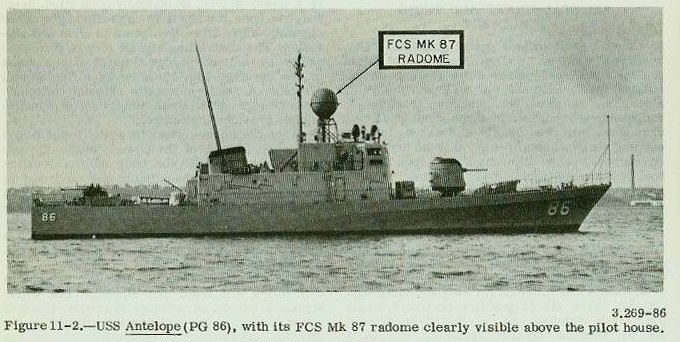
A patrol gunboat’s armament consists of a single 3″/50 gun mount forward, a single 40 mm gun aft, and four .50 caliber machine guns in twin mounts atop the pilot house. Ashville Class PGs, except USS Antelope (PG-86) and USS Ready (PG-87), have Mk 63 gun fire control systems (fig. 11-1). Antelope (fig. 11-2) and Ready have Mk 87 weapons control systems. The PG’s weapons are capable of inflicting heavy damage upon light shipping and enemy personnel ashore.
3″/50 Gun Mount
The 3″/50 used on patrol gunboats (fig. 11-2) is a rapid-fire, semiautomatic, enclosed single gun mount. Although the 3″/50 gun was designed primarily for air defense, it can be used very effectively against surface and shore targets. The 3″/50 gun on a PG is enclosed in a fiber glass shield; 3″/50 guns on other ships may be open mounts or enclosed in either fiber glass or aluminum shields. The description and operation of the 3″/50 gun are covered in chapter 5.
40 MM Mount Mk 3
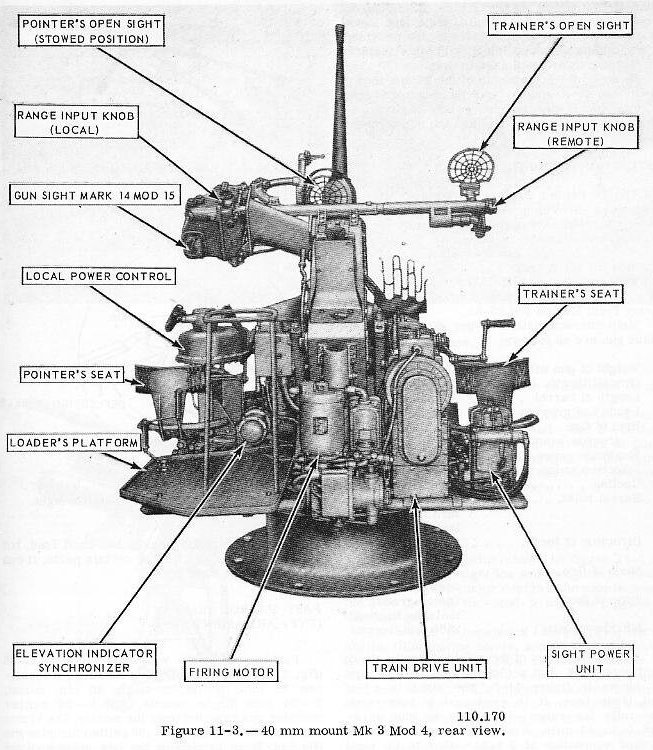
The single 40 mm mount (fig. 11-3) on the PG is a power driven, electrically controlled, dual-purpose open mount. It is controlled by synchro signals, which drive the mount in train and elevation. The controlling signals may be furnished either by a Local Power Control unit mounted on the carriage (fig. 11-3) or by a fire control director. A Local-Automatic selector switch on the carriage determines which set of synchro signals provides the control.
When the Local-Automatic switch is positioned for local control of the power drives, the gun pointer controls both the train and the elevation power drives by manipulating the handgrips of the Local Power Control unit. The pointer tracks the target with a gunsight that is mounted on the gun mechanism and moves with the gun. He may fire the gun electrically by depressing a foot-operated firing switch or manually by depressing the foot-firing pedal.
When the mount is in automatic control, it will follow the train and elevation gun order signals from the director or computer. Electric power firing of the gun can be initiated by the director operator and controlled by the gun crew. Manual gun operation by handcranks is possible whenever power operation is not feasible.
Various safety features such as power-to-manual interlocks, securing pins, firing cut-out cams, power-operated limits, train and elevation positive stops, and buffers are provided. These safety features, along with other features of the mount, are explained in detail in OP 1289.
.50 Caliber Machine Gun (M2HB)
The .50 caliber machine gun on the patrol gunboat is a Browning recoil-operated, belt-fed, air-cooled gun. Although it is primarily an antiaircraft weapon used by the Army, the Navy has adopted it for use aboard ship, against both surface and air targets. The mechanism of the weapon and its principles of operation are described in detail in Army Field Manual FM 23-65.
Main characteristics of the .50 caliber machine gun are as follows:
| Weight of gun with barrel | 84 pounds |
| Overall length | 65⅛ inches |
| Length of barrel | 45 inches |
| Lands and grooves | 8 each |
| Rate of fire | 500 rounds/minute |
| Maximum range | 7,400 yards |
| Effective range | 2,250 yards |
| Cooling | Air |
| Barrel twist | Right hand; one turn in 15 inches |
| Direction of feed | Optional (left or right) |
| Mode of fire | Full automatic or semiautomatic |
| Type of feed | Disintegrating metallic link belt |
| Muzzle velocity | 2,900 feet/second |
The gun normally uses a left-hand feed, but by changing the position of certain parts, it can be fed from the right side.
Fast Patrol Boat (PTF) Armament
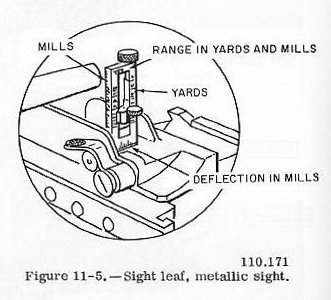
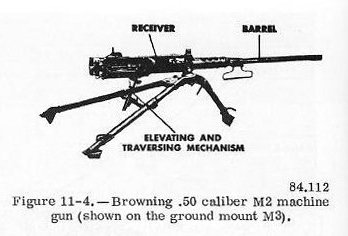
An exterior view of the machine gun is shown in figure 11-4, and a closeup of the rear sight is shown in figure 11-5. The sight is a leaf and blade type. It is graduated in both yards and mils for range — from 100 to 2,600 yards and 0 to 62 mils. A windage screw allows for a wind correction of 5 mils either to the right or the left.
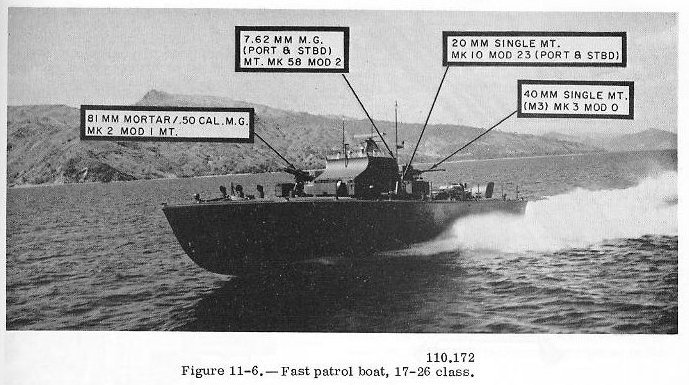
Fast patrol boats with hull numbers 17–26 (fig. 11-6) have the following installed ordnance: one 81 mm mortar, a single 40 mm mount, 2–20 mm single mounts, and one .50 caliber machine gun mounted over the mortar. The 81 mm mortar with its piggyback .50 caliber machine gun (fig. 11-7) is located in the bow section of the boat. One of the 20 mm guns is mounted on the starboard side and the other is mounted on the port side.
PTFs with hull numbers 3–16 have 2–40 mm guns — one forward and one aft — and 2–20 mm guns — one to starboard and the other to port.
81 MM Mortar
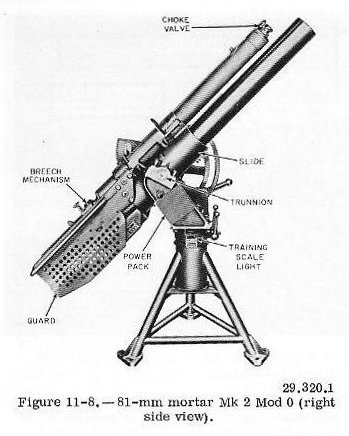
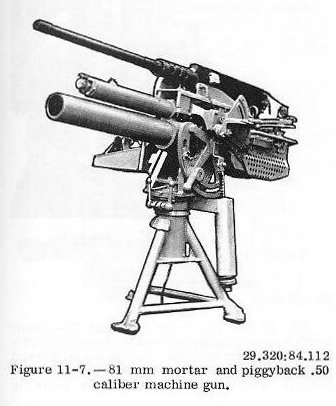
The 81 mm mortar shown in figure 11-7 is a Mk 2 Mod 1 design; the one in figure 11-8 is a Mk 2 Mod 0. The major design difference between the two is that the Mod 1 has the piggyback machine gun.
The mortar is capable of firing high explosive shells, illuminating shells, and white phosphorous (WP) smoke shells. This capability makes it an effective weapon in bombardment, laying smoke screens, and providing nighttime target illumination. Fuzes for the mortar’s ammunition are of two types: point detonating and time. However, there are three types of fuze actions because point detonating fuzes can be either superquick (explode on impact) or delay (activate on impact but explode a fraction of a second later).
The mortar is simple in design. It can be operated by one man, though two usually perform this duty. It is designed for free swinging in both train and elevation for quick change in direction, or it can be fired from a fixed position, by either drop-fire or controlled trigger fire. (In drop-fire, the projectile is fired as soon as it slides down the barrel and hits the firing pin; trigger fire is similar to firing a handgun.)
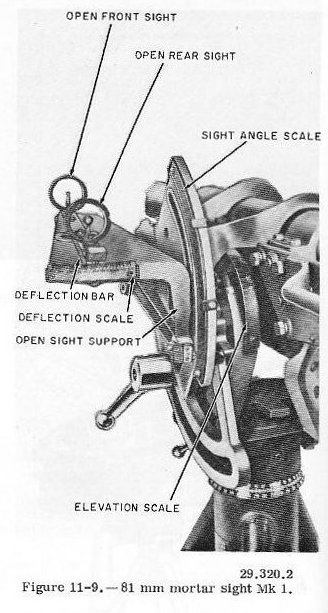
The 81 mm mortar has an open yoke-type sight mounted at the left side of the slide (fig. 11-9). It is a manually-adjusted arrangement with offset limits of 14° 20′ deflection, right and left, and 75° sight angle. The mortar has an elevation scale that is graduated in 5° increments from −30° to +75° and a training scale graduated in 1° increments from 0° to 360°.
Additional information on the 81 mm mortar, which is also mounted on Hydrofoil Gunboats (PGHs) and Fast Patrol Craft (PCFs), can be found in OP 1743.
20 MM Gun
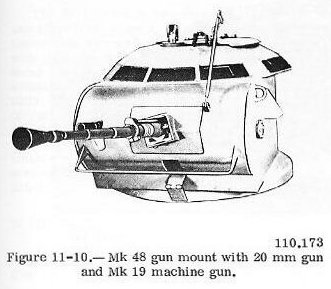
The 20 mm gun on the PTF (and other small craft) was originally designed in the early 1930s for use on aircraft. The first known successful application of this weapon for use on surface vessels was on the Navy’s small boats in Vietnam — boats such as PCFs, PBRs, and ASPBs. The 20 mm gun may be mounted in an open mount arrangement, as on the PTF, or in an enclosed mount (fig. 11-10).
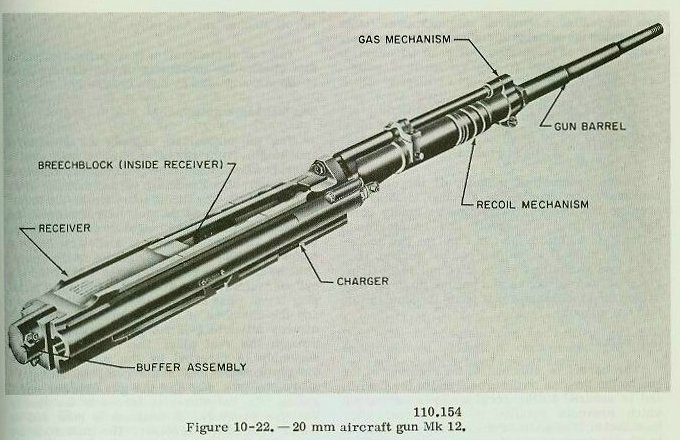
For discussion purposes, the 20 mm aircraft gun may be considered to be divided into seven major components (fig. 10-22): gun barrel, receiver assembly, recoil mechanism assembly, gas mechanism assembly, breechblock assembly, buffer assembly, and charger assembly. These assemblies include all the elements necessary for chambering a round of ammunition, closing and opening the breech, extracting an empty case, and controlling the recoil and counter-recoil actions.
In addition to being useful against aircraft, the 20 mm gun can be used against small craft and personnel. Its primary uses on the Navy’s small boats in Vietnam are against personnel and small craft. A detailed description of the 20 mm aircraft gun can be found in Aviation Ordnanceman 3 & 2, NavPers 10345 series, or OP 3476.
Fast Patrol Craft (PCF) Armament
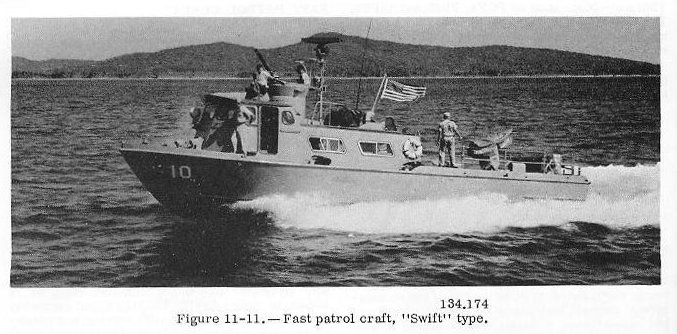
The fast patrol craft, “swift” type (fig. 11-11), is generally equipped with an 81 mm mortar with a piggyback machine gun mount, aft, and a twin .50 caliber machine gun mount atop the pilot house. Also, they may be equipped with a Mk 19, 40 mm machine gun mounted forward of the pilot house and M60 (7.62) machine guns. PCFs, as well as other small boats, are equipped with hand-carried ordnance such as M79 grenade launchers and handguns, as the need arises.
Hydrofoil Gunboat (PGH) Armament
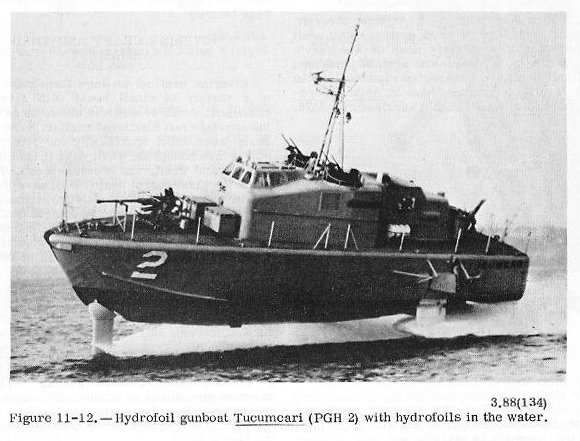
Presently, there are two hydrofoil gunboats in service. Both are armed with one 40 mm gun forward, four .50 caliber (two twin mounts) machine guns atop the pilot house, and one 81 mm mortar aft. Hydrofoil Gunboat Tucumcari (PGH-2) is shown in figure 11-12. Its high speed capability (above 40 knots), ease in maneuvering, and variety of weapons makes it very useful for coastal operations.
Riverine Craft and Their Armament
Riverine craft as we know them today consist of a variety of small boats with a variety of armament, much of which is the same as that for the coastal craft discussed earlier. Some of these boats were built specifically for riverine use; others are converted World War II landing craft, commercial craft, and pleasure craft. They include the river patrol boat (PBR), assault support patrol boat (ASPB), monitor (MON), armored troop carrier (ATC), command and control boat (CCB), patrol air cushion vehicle (PACV), and the river minesweeper (MSR). The armament of a representative number of these craft will be discussed in the following paragraphs.
River Patrol Boat (PBR) Armament
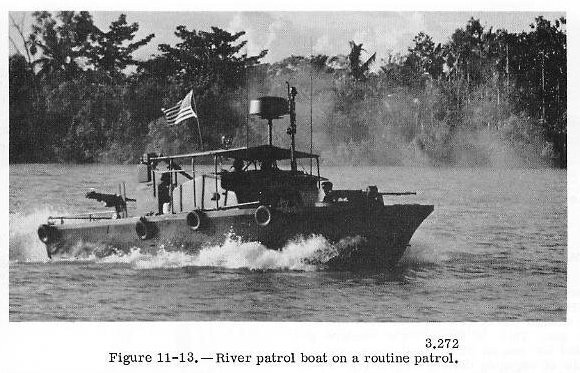
The river patrol boat shown in figure 11-13 is armed with three .50 caliber machine guns and a 40 mm (M79) grenade launcher. The twin machine gun mount is located in the bow section of the boat. The 40 mm grenade launcher is hand carried. The single machine gun is located near the boat’s stern.
The armament of different PBRs varies. Some PBRs have a 40 mm machine gun mounted over the single .50 caliber machine gun. Others have 60 mm mortars and 7.62 mm machine guns in addition to their .50 caliber machine guns and 40 mm machine gun.
40 MM Grenade Launcher M79
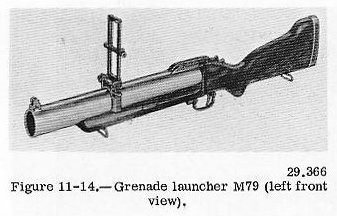
The M79 grenade launcher is a single-shot, shoulder fire weapon. It is breech loading and chambered for a 40 mm metallic cartridge case with internal primer. It is trigger-fired the same as a shotgun — and even resembles one somewhat (fig. 11-14). Because of its versatility, the grenade launcher is issued to most of the riverine craft, and its primary use is the launching of antipersonnel projectiles against enemy ground forces. The operation and maintenance of the M79 grenade launcher is described in Army Technical Manual TM 9-1010-205-12.
60 MM Mortar
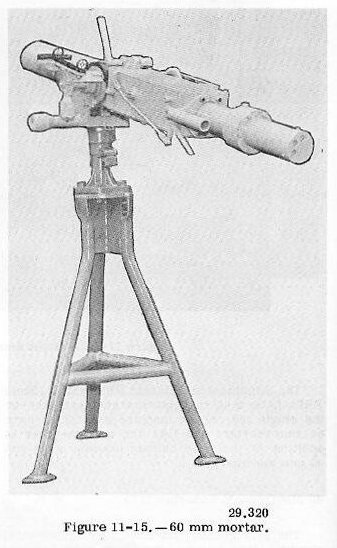
Like the 81 mm mortar, the 60 mm mortar (fig. 11-15) can be used for bombardment, laying smoke screens, and for providing nighttime target illumination. It too has a recoil-counter-recoil mechanism to reduce brake load and a trigger-firing mechanism.
The main characteristics of the 60 mm mortar are as follows:
| Weight | 135 pounds |
| Length | 54¼ inches |
| Width | 14 inches |
| Height | 57¾ inches |
| Mode of fire | Drop or trigger |
| Type of feed | Hand |
| Rate of fire | 10–18 rounds per minute |
| Maximum range | 1,850 yards |
| Effective range | 1,000 yards |
| Muzzle velocity | 493 feet per second |
| Barrel twist | None |
| Barrel length | 25⅝ inches |
| Cooling | Air |
Operationally, the 60 mm mortar is similar to the 81 mm mortar. The major differences between the two are the greater muzzle velocity, larger projectile, and longer range of the 81 mm mortar.
7.62 MM Machine Gun M60
Another weapon that is commonly used on the PBR and other riverine craft (as well as on some coastal patrol craft) is the 7.62 mm machine gun. This is the Army’s machine gun mounted for use on Navy small boats, and it is capable of engaging distant targets (up to 3,200 meters) with a heavy volume of controlled and accurate fire.
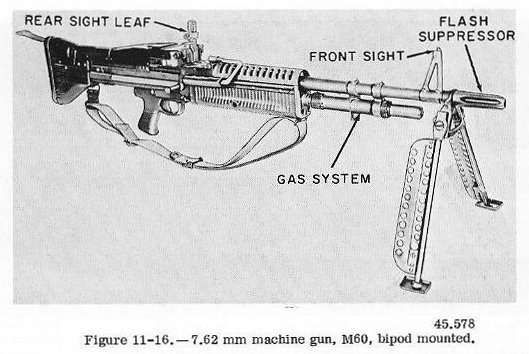
The M60 machine gun (fig. 11-16) is an air-cooled, belt-fed, gas-operated automatic weapon. The ammunition for this weapon, which fires from the open-bolt position, is fed into the gun by a disintegrating metallic split-link belt.
| Caliber | 7.62 mm NATO (.308 caliber) |
| Weight | 22 pounds |
| Length | 43.5 inches |
| Width | 3 inches |
| Height | 5 inches |
| Mode of fire | Automatic |
| Direction of feed | Left hand |
| Type of feed | Ammunition can |
| Rate of fire | 550 rounds per minute |
| Maximum range | 3,200 meters |
| Effective range | 1,100 meters |
| Muzzle velocity | 2,750 feet per second |
| Barrel twist | Right hand, one turn in 10 inches |
| Barrel length | 24 inches |
| Cooling | Air |
The M60 has a front sight permanently affixed to the barrel. The rear sight leaf is mounted on a spring-type dovetail base. The range plate on the sight leaf is marked for each 100 meters, from 300 meters to the maximum effective range of 1,100 meters. Range changes may be made by using either the slide release or the elevating knob — the slide release for major changes and the elevating knob for minor changes. A detailed description of the 7.62 machine gun M60 is found in Army Technical Manual FM 23-67.
Miscellaneous Ordnance
Some PBRs, as well as other small boats, carry night vision equipment, small arms, pyrotechnics, and demolition grenades. The night vision equipment (sight) is used to see enemy movement at night or during poor visibility conditions. It is hand held or mounted on the M16 rifle. Small arms carried by the PBR consist of a 12 gauge shotgun, three M16 (5.56) rifles, two 40 mm grenade launchers, a .38 caliber revolver, and an ordnance locator. The small arms are especially useful for boarding and search operations. The pyrotechnics are used for signaling, by smoke or illumination. The miscellaneous ordnance carried by any boat at a given time will vary according to its assigned mission.
Assault Support Patrol Boat (ASPB) Armament
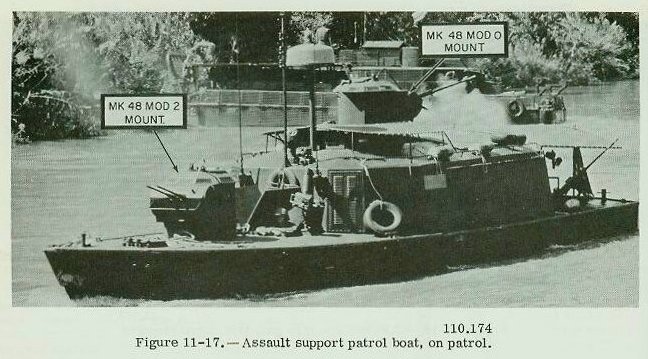
Armament of ASPBs may vary, but generally it consists of two Mk 26 gun mounts (with either .50 caliber machine guns or Mk 20, 40 mm machine guns), two 20 mm machine guns, and two Mk 19 high-velocity grenade machine guns — plus small arms and night vision devices. The ASPB (fig. 11-17), with its assortment of armament, is used mainly for patrolling inland waterways and for supporting troop landings and movements.
Mk 26 Gun Mount
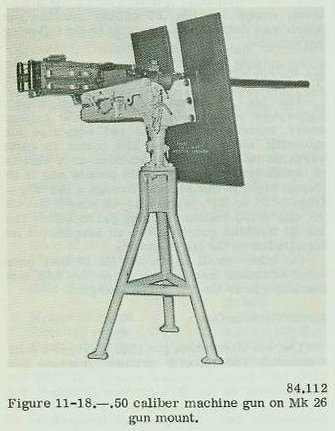
The Mk 26 mount is a universal tripod, lightweight unit developed for the .50 caliber heavy barrel machine gun and adaptable for mounting other weapons. The mount is quite versatile with respect to location on a variety of small boats. It weighs 205 pounds and is 59 inches high. It can elevate through a 100° arc — from −15° to 85°. Figure 11-18 shows the Mk 26 with a .50 caliber machine gun mounted. The Mk 20 machine gun requires an adapter for its installation on the Mk 26 mount. On other small craft, the Mk 26 may have other ordnance mounted — such as the 7.62 mm machine gun or the Mk 20 machine gun.
Mk 20 Machine Gun
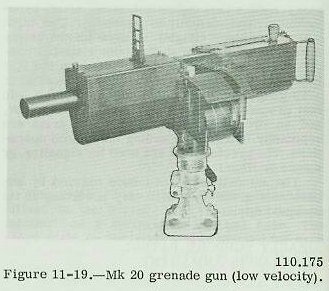
The Mk 20 machine gun (fig. 11-19) is a fully automatic, low-velocity grenade machine gun used as an antipersonnel weapon. It fires the same round as the M79 grenade launcher, and it utilizes a metallic link fed from a 24-round ammunition can. The gun was designed to be pedestal mounted; however, it is recoilless and lends itself to multiple mounting systems such as tripods or bipods or, if necessary, it may be fired from a hand-held position. To fire the weapon, the first cartridge is loaded manually into firing position; after that shot is fired, the remaining operation is automatic or semiautomatic depending upon the mode of fire.
| Caliber | 40 mm |
| Weight | 26 pounds |
| Length | 27 inches |
| Width | 9 inches |
| Height | 7 inches |
| Mode of fire | Full automatic or semiautomatic |
| Direction of feed | Left hand |
| Type of feed | Mechanical, link |
| Rate of fire | 250 rounds/minute |
| Maximum range | 400 meters |
| Effective range | 350 meters |
| Muzzle velocity | 2,950 feet/second |
| Barrel twist | Right hand, one turn in 48 inches |
| Barrel length | 12 inches |
| Cooling | Air |
This weapon, with its relatively high rate of fire, can inflict heavy damage upon enemy troops.
Mk 48 Gun Mount
The Mk 48 gun mount is a medium-armored, small-caliber, flexible multiple-gun mount for use on small craft employed in patrol, escort, and support duties. The mount provides fire power effective against other small craft as well as personnel and shore emplacements. It has unobstructed peripheral vision for easy target recognition from all angles.
The Mk 48 mount comes in several mods. The Mod 0 mount has one Mk 19 machine gun and one 20 mm machine gun; the Mod 1 has one Mk 19 machine gun and two 7.62 mm machine guns; and the Mod 2 has one Mk 19 machine gun and two .50 caliber machine guns. The mount is 39 inches above the deck. It is manually operated through 360° in train and can be elevated from −15° to 65°. It has a periscope-type sight for daytime use and a light amplification type for use at night.
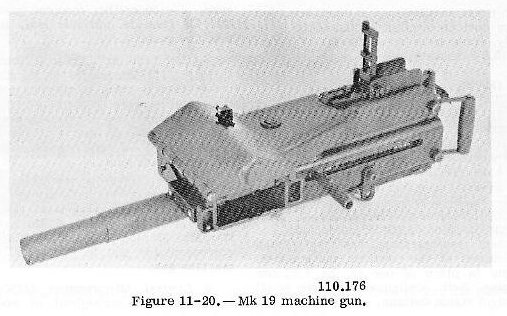
The Mk 19 machine gun (fig. 11-20) is a mechanically-fed, blowback-operated weapon designed to fire 40 mm high velocity grenades. It can be fired by hand or remotely by using a solenoid.
| Caliber | 40 mm |
| Weight | 46 pounds |
| Length | 34 inches |
| Width | 8.5 inches |
| Height | 7.5 inches |
| Mode of fire | Full automatic or semiautomatic |
| Direction of feed | Left to right |
| Type of feed | Mechanical, link |
| Rate of fire | 375 rounds/minute |
| Maximum range | 2,200 meters |
| Effective range | 1,600 meters |
| Muzzle velocity | 800 feet/second |
| Barrel twist | Right hand, one turn in 48 inches |
| Barrel length | 12 inches |
| Method of operation | Advanced primer ignition |
| Cooling | Air |
Although the Mk 19 40 mm machine gun was initially designed for use on the Mk 26 deck mount or on the Mk 48 shielded mount, further adaptation has enabled it to be used in other applications (e.g., by ground forces and in some helicopters).
Miscellaneous ASPB Armament
The ASPB has an allowance of small arms and night vision devices similar to that of the PBR. Additionally, some have two 4-tube Mk 47 rocket launchers (3.5 bazookas).
Monitor (MON) Armament
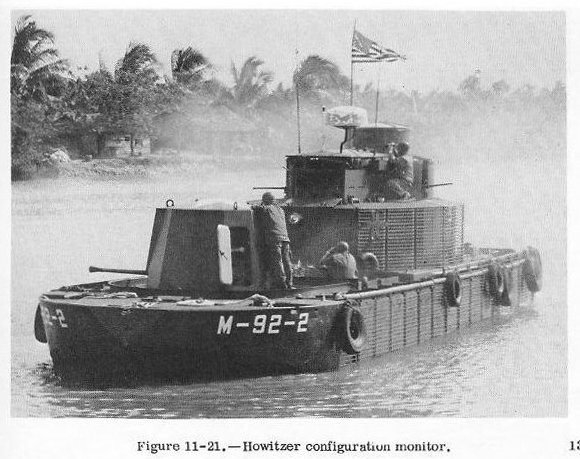
The monitor, a converted landing craft (LCM), provides fire support for riverine operations. It has two basic hull configurations — the Howitzer and the Flame System. The Howitzer configuration (fig. 11-21) has a 105 mm howitzer mount forward, two Mk 48 Mod 0 gun mounts aft (one to port and the other to starboard), and two 7.62 machine guns installed on Mk 26 gun mounts. The flame system configuration has two flame throwers instead of the howitzer and a Mk 20 machine gun in place of one of the 7.62 mm machine guns. Both configurations have small arms and night vision devices.
The heavily armored monitor is popularly referred to as the “battleship” of the riverine fleet. Its 105 mm howitzer or flame thrower gives it added punch in routing the enemy.
Other Coastal and Riverine Craft and Their Armament
The Navy has several other types of coastal and riverine craft. Some are used for one specific purpose while others have multiple uses. Whether these craft are in an active or a reserve status depends upon the current requirement.
1. Patrol Air Cushion Vehicle (PACV)
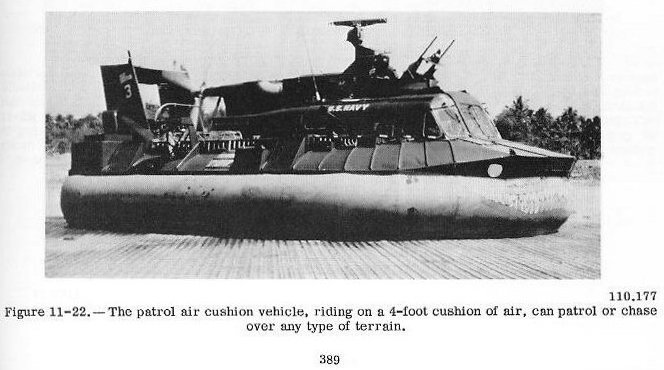
The PACV (fig. 11-22) travels on a cushion of air about four feet thick. Flexible air-actuated trunks provide obstacle clearance and ditch-crossing capability over land and improved riding qualities over water. The PACV has been highly successful in its operation in the marshy plains of South Vietnam. It is armed with a twin Mk 56 .50 caliber machine gun mount, two 7.62 mm machine guns, and two 40 mm grenade launchers.
2. Armored Troop Carriers (ATCs)
These craft were converted from LCM-6 landing craft. Their main purpose is to transport troops, small vehicles, field artillery, and supplies. Heavily armored, they are fitted with steel helicopter platforms to facilitate evacuation of wounded personnel, logistics resupply, and as emergency landing platforms for damaged helicopters. Their armament consists of one or two 20 mm machine guns, two .50 caliber machine guns, one 40 mm Mk 19 grenade machine gun, and two Mk 20 machine guns.
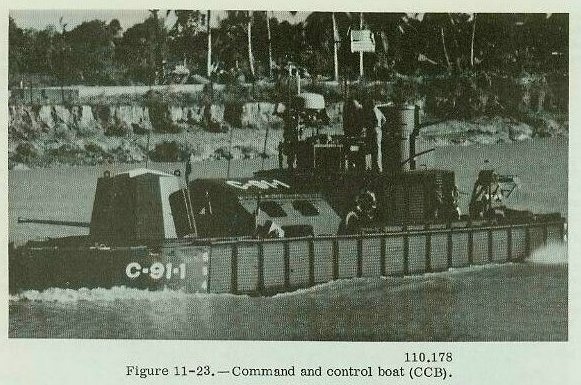
3. Command and Control Boat (CCB)
The CCB (fig. 11-23) serves as an afloat command post, which provides command and communications facilities for ground force and boat group commanders. They are heavily armored and are armed with two 20 mm machine guns, two .30 caliber (or 7.62 mm) machine guns, and two Mk 19 machine guns.
4. River Minesweepers (MSR)
River minesweepers are converted landing craft. They are heavily armored craft that are used for clearing mines from the rivers. MSRs are armed with two Mk 48 Mod 0 mounts amidships — one to starboard and one to port — and a .50 caliber machine gun.
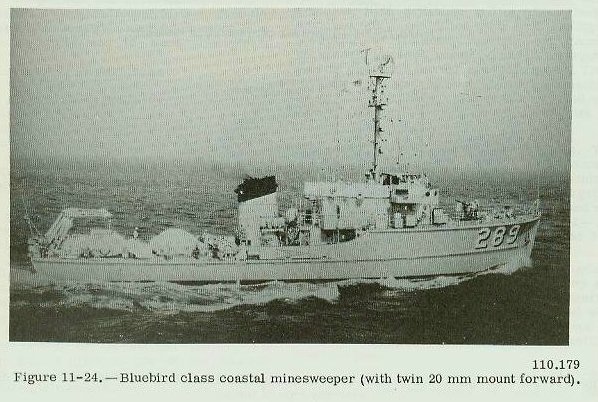
5. Coastal Minesweeper (MSC)
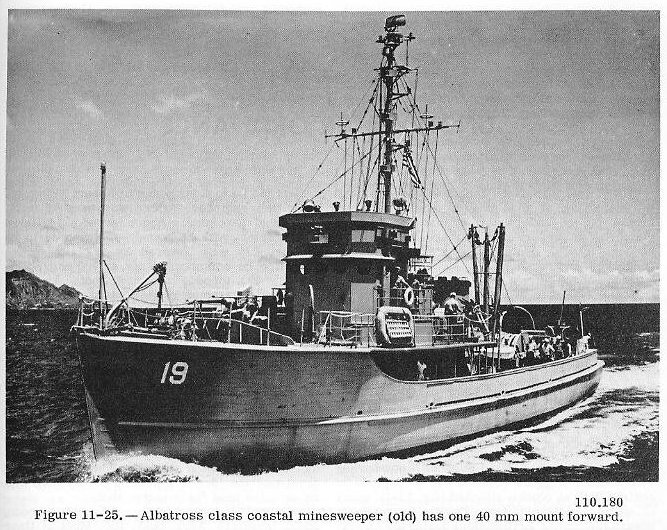
The MSC is constructed throughout of wood and other materials with a low magnetic attraction. The Bluebird Class (fig. 11-24) has one twin 20 mm mount forward. The Albatross Class (fig. 11-25) are classified as MSCOs and have a single 40 mm mount forward.
These are but a sampling of the various small boats used in coastal and riverine operations. Again, bear in mind that the armament may vary considerably from boat to boat. For example, the armament on one PBR may be quite different from the armament on another PBR.