
ASROC (for Anti-Submarine ROCket) is an all-weather, all sea-conditions anti-submarine missile system. Developed by the United States Navy in the 1950s, it was deployed in the 1960s, updated in the 1990s, and eventually installed on over 200 USN surface ships, specifically cruisers, destroyers, and frigates.
After a surface ship, patrol plane, or anti-submarine helicopter detects an enemy submarine by using sonar and/or other sensors, it could relay the submarine's position to an ASROC-equipped ship for attack. The attacking ship would then fire an ASROC missile carrying an acoustic homing torpedo or a Nuclear Depth Bomb (NDB) onto an unguided ballistic trajectory toward the target. At a pre-determined point on the missile's trajectory, the payload separates from the missile and deploys a parachute to permit splashdown and water entry at low speed with minimum detectable noise. The water entry activates the torpedo, which homes in on the target using either active sonar or passive sonar.
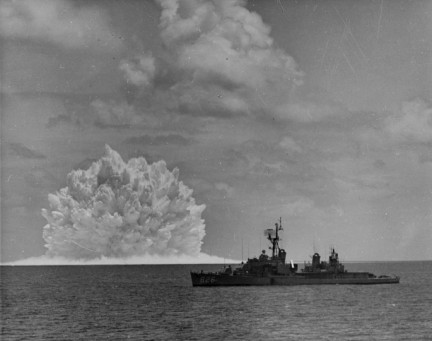
In cases where the ASROC missile carried an NDB, the unguided bomb would sink quickly to a predetermined depth where it would detonate. The nuclear-armed ASROC was never used beyond one or two tests in 1961–62. Eventually the Limited Nuclear Test Ban Treaty banning underwater nuclear tests went into effect, and the nuclear weapon was never used in combat. An ASROC missile could hypothetically carry a 10-kiloton W44 nuclear warhead, although the W44-armed weapons were retired by 1989 and all types of nuclear depth bombs were removed from deployment.
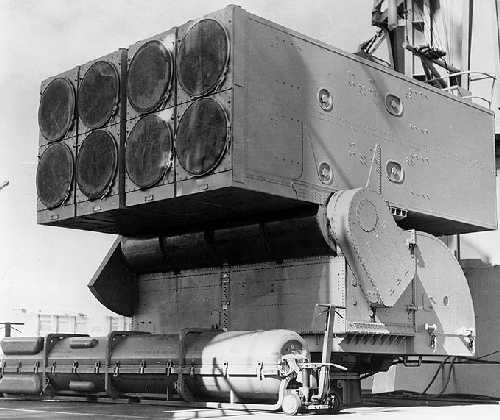
The 31 US Navy Spruance-class destroyers were all built with the Mark 16 Mod 7 ASROC Launching Group and MK 4 ASROC Weapons Handling System (AWHS) reload system. Each had one standard Mark 112 octuple ASROC launcher located immediately above a reload system holding an additional 16 assembled rounds — two complete reloads of eight missiles each — giving each Spruance-class destroyer a maximum total of 24 ASROC. Most other US Navy and allied navy destroyers, destroyer escorts, frigates, and several classes of cruisers carried only the one ASROC “matchbox” MK 112 launcher with eight missiles, although later in service some could be replaced by the Harpoon anti-ship missile.
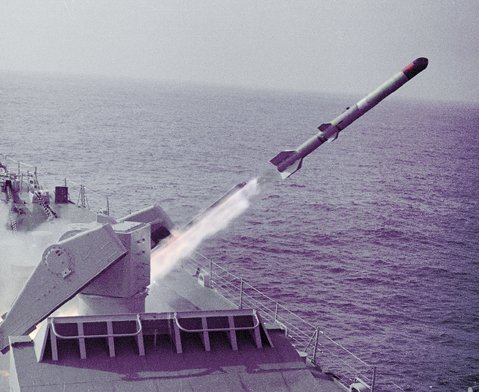
The “matchbox” Mk 112 launchers were capable of carrying a mixture of the two payload types. Reloads were stowed in many classes either on the first level of the superstructure immediately abaft the launcher, or in a separate deckhouse forward or abaft the Mk 112. The MK 16 Launching Group also had configurations supporting the Harpoon RGM-84 (aboard Knox-class Destroyer Escorts) or a variation of the Tartar missile in limited distribution. Ships with the Mk 26 GMLS and late marks of the Mk 10 GMLS aboard the Belknap class could accommodate ASROC in those power-loaded launchers (the Mk 13 GMLS was not able to fire the weapon, as the launcher rail was too short). Most Spruance-class destroyers were later modified to include the MK 41 VLS, capable of carrying a mixture of VL-ASROC, the Tomahawk TLAM, and other missiles. All Spruance destroyers also carried two separate quad Harpoon launchers, and other US ships with the Mk 41 can likewise accommodate VL-ASROC.