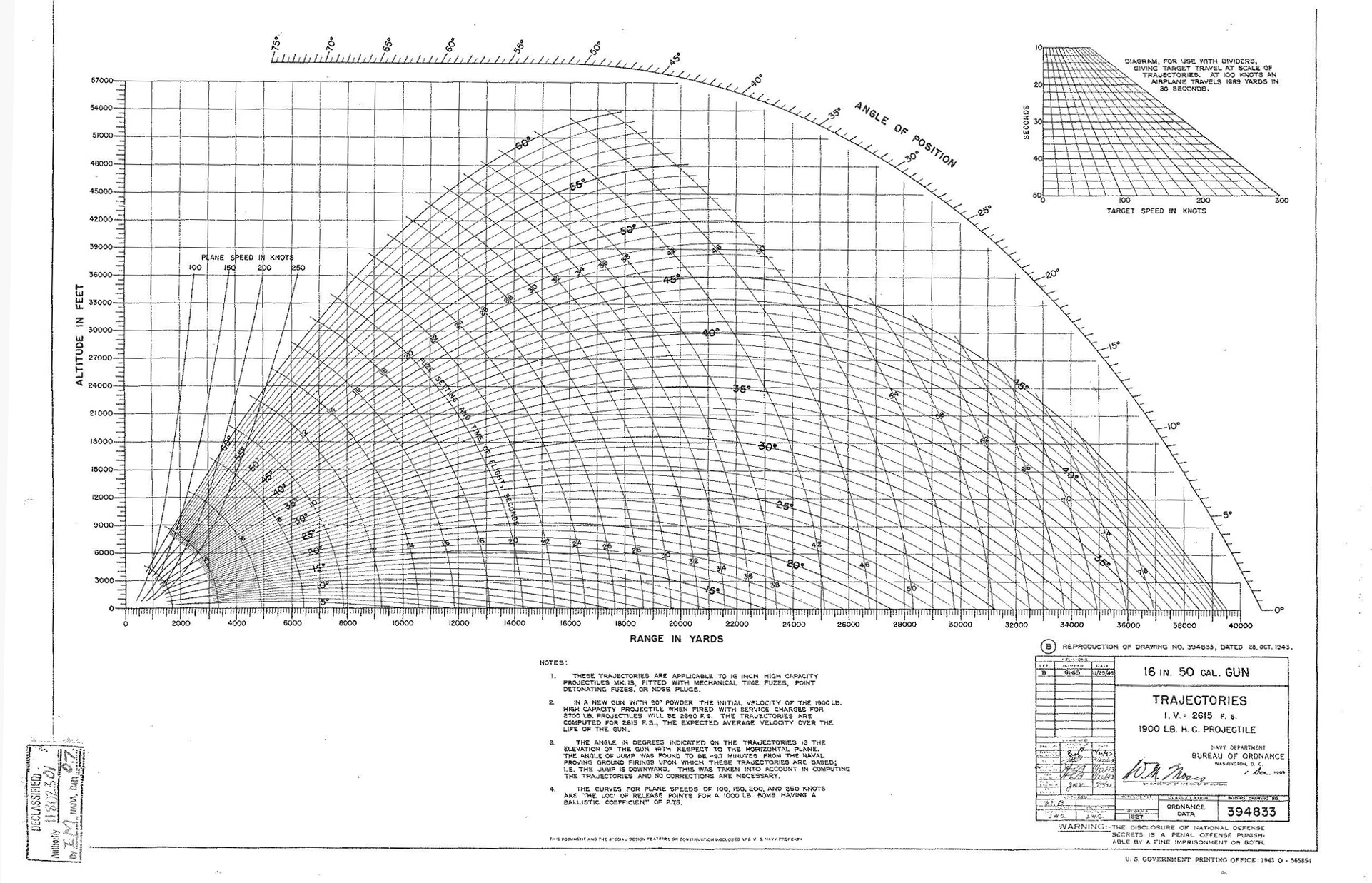
As gun elevation increases the range pattern decreases in length. The trajectory chart at the bottom of this page shows the decrease in range as gun elevation increases — this happens because as gun elevation increases, its effect on increasing range diminishes. This is especially evident when firing 9-gun salvos.
We checked our pattern size in length as well as bearing by firing 9-gun salvos starting at 10,000 yards and increasing range in 5,000-yard increments out to 40,000 yards. Refer to OP 1100 — Range Tables for the 16″ HC 1,900-lb Projectile to see how increasing gun elevation decreases the effect on range.
I and other interested parties would stand on the pilot house and watch each salvo as it fell into the ocean. It always fascinated me that the pattern size in range decreased as gun elevation increased. I really liked watching the pattern size decrease as we marched the range of the salvos out in 5,000-yard increments. Watching from atop the pilot house was much more impressive than watching it on the Mark 8 radar.
In these firing tests we were looking to see if we had a gun firing erroneously and therefore out of the pattern. If this happened it was easy to spot during these firing exercises and then determine which gun was the problem and what was wrong with it.
These exercises also showed that the first best chance to get a hit always occurs at maximum gun range. At maximum gun range the range pattern is about 200 yards long and the fall of shot is at about 50 to 55 degrees. This narrow range pattern plus the high angle of fall is then the first best chance to get a hit.
The chance of a hit decreases as gun elevation decreases and is least at about three-quarters gun range. At about three-quarters gun range the range pattern is about 400 to 500 yards long and the fall of shot is at about 30 to 35 degrees. This means that the target would have to be very tall to even hope to get a hit — in a pattern 400 to 500 yards long, a 110-foot-wide Iowa-class battleship can be missed quite easily, and a smaller ship even easier.
As gun elevation continues to decrease, the chance of a hit begins to increase at about 50 percent of gun range and continues to increase as gun elevation decreases further. At about 15 degrees of elevation the range is about 50 percent of maximum. At this elevation the gun is shooting through the target, and accurate range to target is not very important.
Working Out the Pattern Math
The following worked example shows how to calculate pattern size at any range using the range table. Start with a known pattern and gun elevation, then apply the same angular spread to find the pattern size at a different range.
Say you fire a salvo at 30,000 yards; gun elevation at 30,000 yards is 21° 28.4′. If the range pattern is 600 yards long, the end of the pattern falls at 30,600 yards, where gun elevation is 22° 13.3′. Subtract 21° 28.4′ from 22° 13.3′ to get an angular spread of 44.9 minutes.
Now apply that same 44.9-minute spread at 20,000 yards, where gun elevation is 11° 23.6′. Add 44.9 minutes: 12° 8.5′ corresponds to a range of about 20,900 yards — so the range pattern at 20,000 yards with the same angular spread is about 900 yards long, half again as long as the 600-yard pattern at 30,000 yards.
You can select any range pattern length and place it anywhere in range; the angle you get tells you the length of that same pattern at any other range in the table. If you prefer not to do the math, the trajectory chart below shows clearly how the pattern shrinks as gun elevation increases.