
I get e-mail from all over the world, usually commenting on one page or another. Every once in a while I get something really special. This is one such time. While watching a WWII video, a Marine who was severely wounded invading Tarawa (in the first amphibious vessel) recognized himself on a stretcher. His daughter sent the following e-mail along with her father’s firsthand story from that time. — Gene.
Sailors’ Stories: WWII Veteran James Payton
One of Two Survivors from the First Amphibian Tractor to Land at Tarawa
⚓
Gene,
I was watching this video with my father. He was so shocked to see himself in the video. He turns 90 in Nov. 2011 and is living in Kansas.
My dad is James G. Payton. He was in the 2nd Marines, made up of the 1st Wave. He was on the first amphibian tractor. On ship was 25 Marines, 1 Naval Officer, and 2 tank drivers. Everyone died but 2 — my dad and his high school friend, Bud West.
Bullets were splashing around them. The minute they decided to head to the beach, my dad was hit in the leg. To this day, my dad does not know how he got on the beach. At the end of the second day his friend Bud located two corpsmen with a stretcher to carry him to a transport ship. At 3:25 in this 8-minute video we can see my father on the stretcher with his right leg injured. The shell broke his tibia bone and severed the nerves in his right leg.
This is so amazing. I have heard my father talk about Tarawa since I was a little girl. Now, after seeing this video, it has given me so much more perspective on what he went through.
Thank You,
Jan Jabara (Payton)
▶ Tarawa WWII — James Payton Appears at 3:25: 8 minutes

The following story is from the personal war diary and recollections of Mr. Payton and contains graphic descriptions of some events:
WORLD WAR II STORY — By James G. Payton Jr.
I graduated from Wichita North High School in 1941. Soon after graduation I was offered a job with the American Optical Company. On December 7, 1941, the Japanese attacked Pearl Harbor. My boss said that he would sign up if he were younger. The Marine recruiting office was in the Post Office. Since I was in the building four times each day, I stuck my head in the recruiting office. They said, “come on in.” They counted my teeth, checked my vision and asked a few questions and said, “You are the type of man we want. Sign here!” I had some explaining to do with my folks and my boss. Thirty of my friends signed up also. In less than a week we were sent to Kansas City for induction into the Marines.
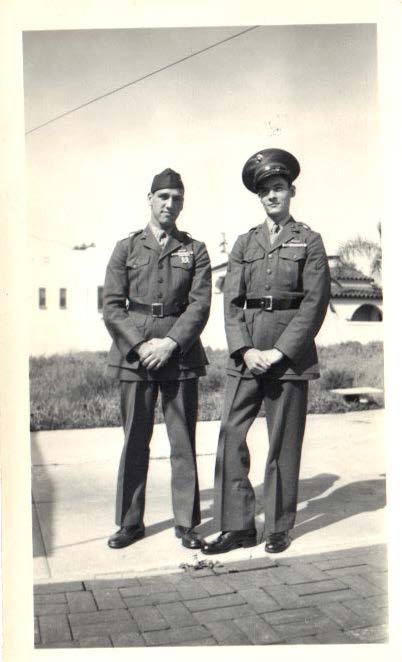
After induction we boarded a train — destination: U.S. Marine Base in San Diego, California. We entered boot training as young boys and came out men. We only thought we were men. Our true test of manhood was after one day of battle. We were taken to the dock where we boarded the Matson Liner. We were at sea for eight to ten days with no idea where we were going. We landed at Pago Pago Harbor, Samoa. At Samoa they issued new equipment, steel helmets and new M-1 rifles. We received jungle training for about two months, then boarded ships and made practice landings on the Island of Fiji.
Next stop: Guadalcanal. When we arrived, I worked with a group to help unload the ship. While unloading, the Japanese attacked us, so we quickly went out to sea then returned the next morning to finish. When I finally got ashore, my buddies said to hurry and dig a foxhole. There was an air raid in progress. Our pilots were superior and shot most of the Japanese planes out of the sky.
We finally reached the front line and spent thirteen days in the same spot fighting. Some days we would throw our empty cans at them; they would throw them back. One day I was bored so I went out to do a little hunting on my own. A Zero spotted me and decided to strafe me. He missed on his first pass, then a sniper zeroed in on me. The bullet hit some coral and shattered it, cutting my hand. I was sent to Red Beach hospital. The doctor stitched up my hand and said, “I guess you qualify for a Purple Heart.” I refused. I asked them to give me a new rifle and take me back to my outfit.
Our next assignment was to drive the Japanese into the ocean. We eventually reached the front lines, where we used flame-throwers to flush the enemy out of caves. Most of them would commit harakiri. We didn’t take many prisoners. After three months on Guadalcanal — short many men, suffering from malaria, yellow jaundice, and weak from lack of food — they sent us to New Zealand for R&R and to rebuild our personnel. On my first liberty I went into Wellington and ate five steak and egg dinners plus ice cream sundaes, milkshakes, and cream puffs in a 12-hour period.
After nine months of grueling Marine training we were ready to tackle our next assignment. Colonel Crow told us, “We have been chosen to hit the Island of Tarawa. The 2nd Marines will make up the 1st wave. We will be facing 5,000 seasoned Japanese troops. Casualties will run about 87%.”
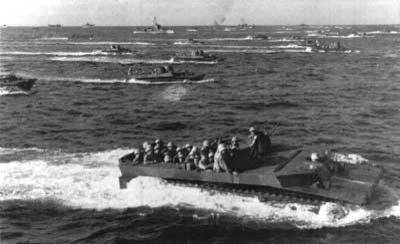
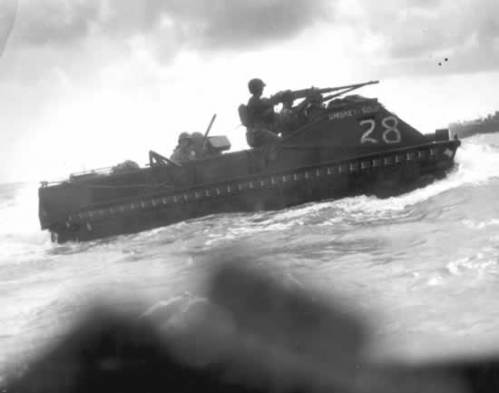
When we reached the debarkation location, there were transport ships full of Marines, cruisers, battleships, and aircraft carriers. We received our usual steak dinner before a battle. We did not sleep that night. I was assigned to the #1 amphibian tractor in the first wave. We carried 25 Marines, 1 Naval Officer, and 2 tank drivers. It was very difficult climbing down the cargo net with a full pack, cartridge belt, two bandoleers, rifle, bayonet, and about 6 hand grenades.
There was a coral reef 1,000 yards out from shore. The tide would be low. The amphibian tractor would climb over the reef where regular landing craft would be forced to stop at the edge, forcing men to wade 1,000 yards in 2 to 3 feet of water — that would have been disastrous. The battleships began firing their big guns. You could see the red-hot shells pass over our heads, the size of a Volkswagen car.

We started in and “all Hell broke loose.” I was loading one of two 50-caliber machine guns mounted on the front of our tractor. After traveling about 10 yards past the reef, we were hit. The two men driving the tractor fell back against my legs. They were dead. The Marine shooting the machine gun I was loading “exploded like a light-bulb.” I came to and decided it was time to get out. My friend from my hometown and the Naval Lieutenant also got out. The tractor took two more direct hits. The Lieutenant had lost part of his face. He died.
I looked at my friend; bullets were splashing all around him. I said, “Bud, let’s head for the beach.” He said, “You go first and I will follow.” I took about two steps. My right leg flew up over my head. To this day, I will never know how we made it to the beach.
We managed to hold on to our rifles. Later that morning a medic gave me a shot of morphine and put sulfa powder and a bandage over the hole in my leg. The severe fighting was over by the end of the second day. There were 1,027 Marines killed and 2,292 wounded. All but about a half-dozen of the 5,000 Japanese were killed. At the end of the second day my friend Bud West located two corpsmen with a stretcher to carry me to a transport ship setting offshore.

When they got me on board, they started working on my neck. I told them they were working on the wrong spot — it’s my leg. The shell broke the tibia bone and severed the nerves in my right leg. They cleaned and bandaged it, then put me down in the hold of the ship. This was very depressing. While in New Zealand I had purchased a chain with a cross on it. I was in pain and depressed, so I pulled the cross and chain from my neck and threw it to the floor. A priest saw this and the next thing I knew they moved me up topside where it was cooler and more pleasant.
Eventually I ended up in a beautiful all-white hospital ship with a cast on my right leg up to my hip. The next thing I knew we were in Hawaii. Then I boarded another ship and ended up in San Francisco, where they put me on a train to Corona, California. I spent 18 months in Corona. My right leg was paralyzed, so I underwent four different surgeries and a lot of therapy so I could walk again. They gave me $300 separation pay, a Purple Heart, and sent me home.

War buddies — James (left, center, then right)
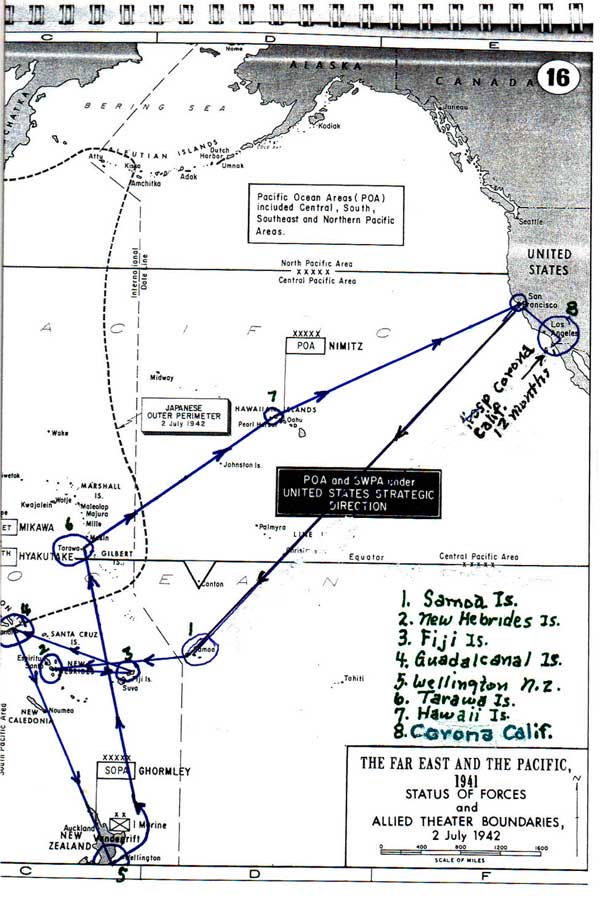
Mr. Payton’s Path
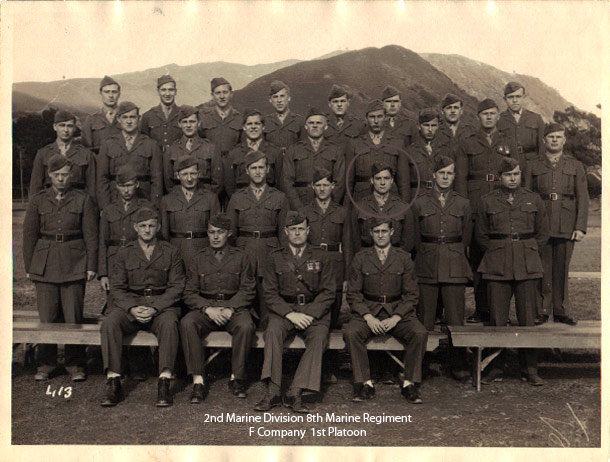
Battle Ready

Letter from Public Relations
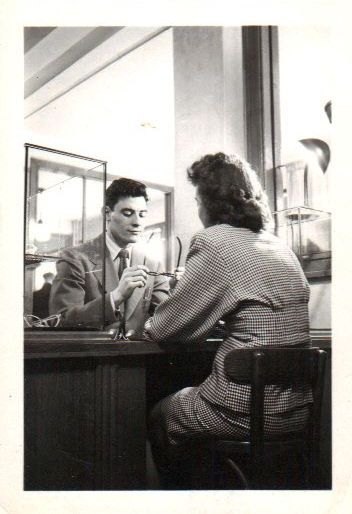
After the war, Mr. Payton opened Payton Optical, shown here in 1949.
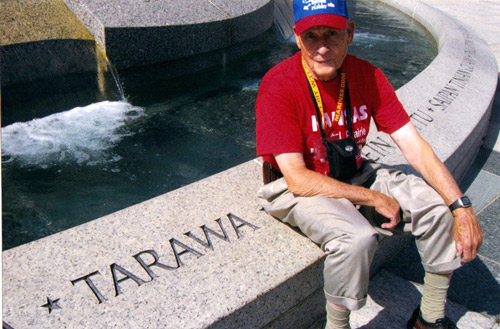
In 2009, Mr. Payton’s daughter Jan escorted him and 43 other WWII Veterans on a Central Prairie Honor Flight to visit the WWII monument in Washington DC. “I have never seen my dad so proud in his life, than when he sat by this memorial of WWII.”
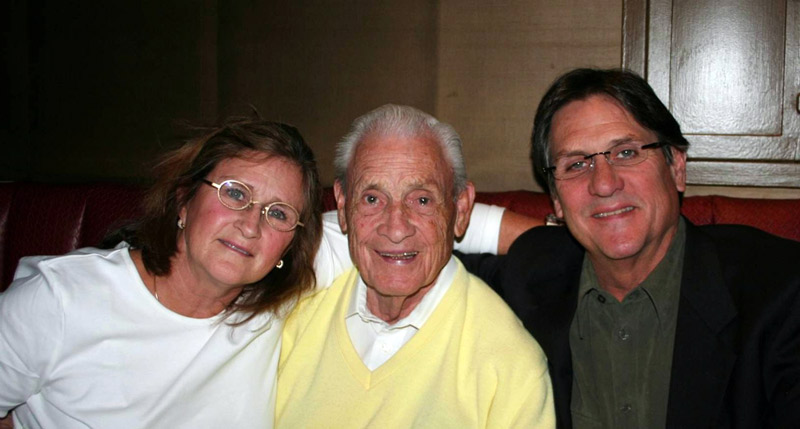
James G. Payton II at his 90th Birthday with his daughter Jan and son James G. Payton III (Greg).
From his daughter, Jan: My dad was interviewed at the Truman Library about 10 years ago and his picture is on the wall at the Bob Dole Archives, where he was honored at the grand opening with Bob Dole. My mother (née Phyllis M. McBride) kept every letter he sent her, from the time he departed the Kansas City train depot until the time he arrived back in Wichita, KS as a WWII Hero. They met at North High School in Wichita, Kansas.
✉ Enjoyed This Page?
Get a free email whenever a new page like this goes up — original gun books, ordnance pamphlets, and wartime film straight from the archive. No spam, unsubscribe any time.
Subscribe for Free →