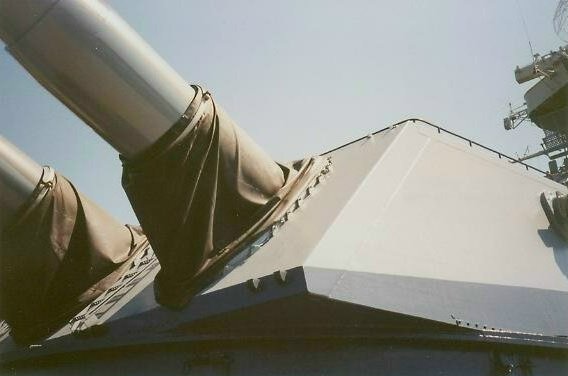
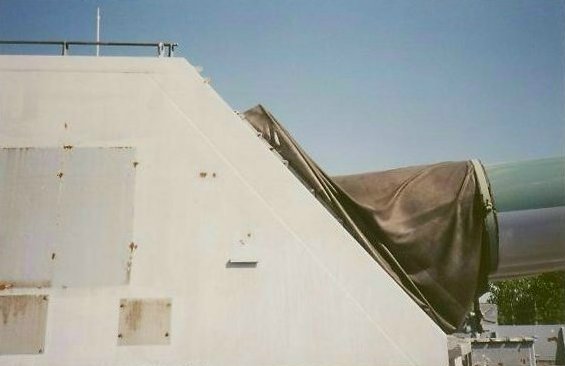
Bloomers maintain the seal at the opening between the gun barrel and turret or rangefinder and director while they change elevation.
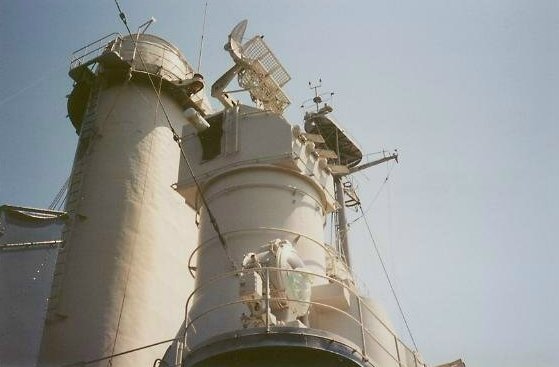
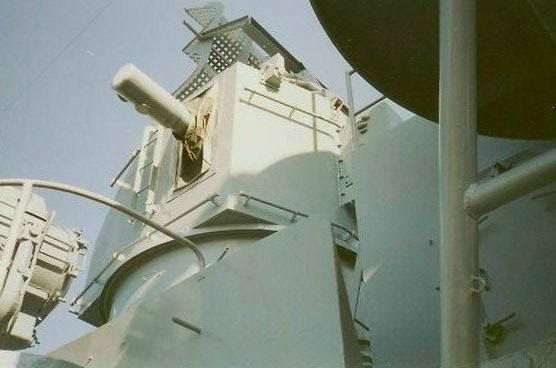
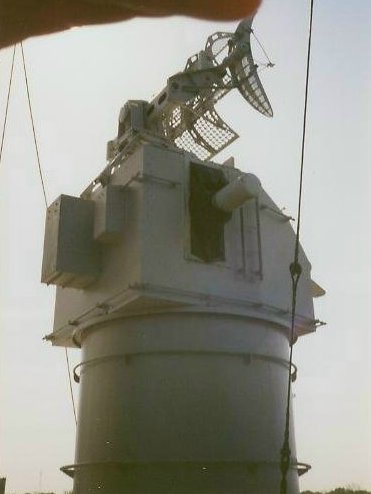
The rangefinder sticks out each side of the Mark 37 director about 3 feet. Level (l) and crosslevel (zd) are transmitted to the director from plot. There is a slot in each side of the director for the rangefinder to pivot up and down in response to crosslevel (zd). The directors were built before radar came along and when radar came the antenna is attached to the same power drive as the rangefinder was so the rangefinder and the radar antenna both pivot together in response to (zd) crosslevel.
The crosslevel motor drives both the rangefinder and the antenna at the same time. When crosslevel reaches 17½ degrees a limit switch stops the crosslevel motor, and when the ship rolls the other direction, as soon as crosslevel becomes less than 17½ degrees the crosslevel motor starts to drive again.
The crosslevel motor also drives the director telescopes, keeping the pointer and trainer telescopes as well as the officer’s slewing sight level.
The director also receives level (l) from plot and the level motor drives the rangefinder, radar antenna, pointer and trainer telescopes as well as the officer’s slewing sight level.
Due to the length of the rangefinder, the 17½ degree movement of the rangefinder requires a very large slot in each side of the director, about 3½ feet long.
To keep the director watertight, a bloomer made of canvas and painted with a waterproof paint allows unrestricted movement of the rangefinder and keeps sea water and spray out of the director.
These are 16"/45 guns with rubber bloomers. The rubber bloomer is a one-ply rubber sheet just under ⅛" thick. The one ply in the center of the rubber sheet is made of cotton and the rubber is vulcanized to both sides of the ply of cotton. These ships keep a roll of the rubber sheeting and cut it to fit. You can see a strap around the gun barrel which holds the rubber sheeting to the gun barrel. The other end of the rubber sheeting is held securely to the faceplate with a metal ring which bolts to the face plate.
A few salvos will shred the rubber sheeting and it has to be replaced as soon as possible to keep the sea water from washing the grease off the gun shields, which keeps them from wearing, and then water comes through into the turret.
The rubber sheeting has to allow for the gun recoil which is just short of 48".
The 16"/50s of the Iowas had this same rubber sheeting for bloomers when first built. Sometime during the Korean War these were replaced with neoprene gun bucklers.